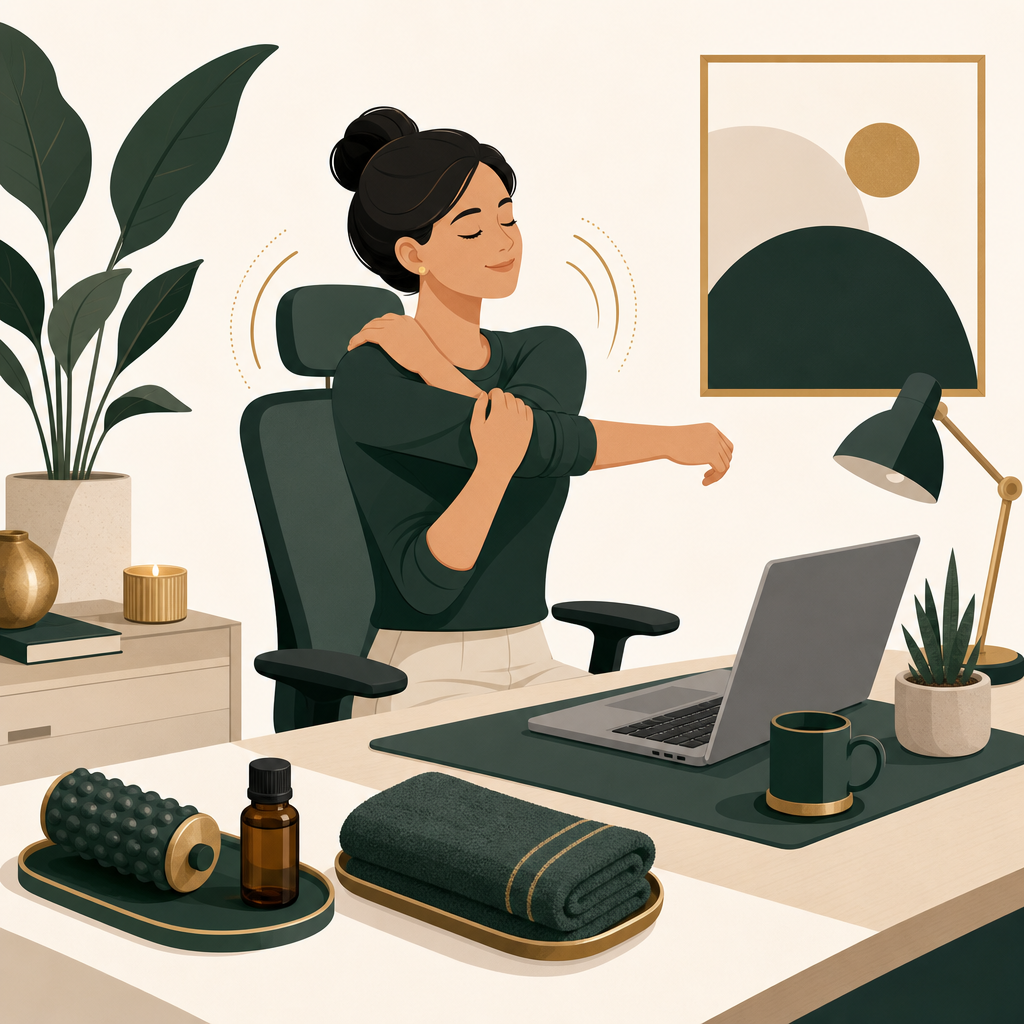
Office Worker's Guide: Desk Stretches and Weekly Massage Plan
If you're reading this while hunched over a laptop in a chair that cost your company ₹3,000 and was never designed for human spines, I have news for you — your body is keeping score. Every hour you sit at a desk, your muscles are shortening, your joints are stiffening, and your posture is gradually, insidiously getting worse. And the worst part? You probably don't even feel it happening until something snaps.
I've been in the wellness industry for years at Raipur SPA in Samta Colony, near Agrasen Chowk, and I've seen the same pattern play out with hundreds of office workers. They come in complaining of "mysterious" shoulder pain, chronic headaches, or a lower back that's been "acting up." They've tried painkillers, they've tried ignoring it, they've tried switching chairs — nothing works. And the reason is simple: you can't medicate your way out of a structural problem caused by eight hours of poor positioning every single day.
This guide is going to cover two things that actually work. First, a set of desk stretches you can do without leaving your chair — because I know you're not going to the gym at 2 PM. Second, a weekly massage plan that addresses the specific muscle groups that desk jobs destroy. Combine these two approaches, and you're not just treating symptoms — you're fixing the root cause.
The Anatomy of Desk Damage — What's Actually Happening to Your Body
Before we talk solutions, let's talk about what's going wrong. Because understanding the "why" makes you infinitely more likely to do the "what."
When you sit at a desk for prolonged periods, several things happen simultaneously:
Your hip flexors shorten. The psoas muscle — a deep hip flexor that connects your lower spine to your upper thigh — is constantly in a contracted position when you sit. Over hours and days, it adapts by literally getting shorter. This pulls your pelvis forward, creating an anterior tilt that strains your lower back.
Your chest muscles tighten. Reaching forward to type or use a mouse keeps your pectoral muscles in a shortened state. They tighten up, pulling your shoulders forward and inward. This is what creates that "computer guy hunch" that makes your shoulders round forward.
Your upper back weakens. The muscles between your shoulder blades — your rhomboids and middle trapezius — are designed to keep your shoulders back and your spine upright. But when you sit hunched forward, these muscles are in a constantly stretched position. Stretched muscles are weak muscles. Weak muscles can't hold your posture. It's a downward spiral.
Your neck takes the brunt. For every inch your head moves forward from its neutral position, the effective weight on your cervical spine doubles. Your head weighs about 5 kg. If it's six inches forward — which is where most people hold it while looking at a screen — your neck is supporting the equivalent of 20 kg. All day. Every day.
Your glutes go to sleep. The term "dead butt syndrome" is real and clinical. Your gluteal muscles, which are the largest and most powerful muscles in your body, essentially stop firing when you sit for long periods. Other muscles have to compensate, and they're not designed for the job.
This isn't a list of potential problems — this is what's happening in your body right now, whether you feel it or not. The pain will come. It's just a matter of time.
Desk Stretches: The 10-Minute Routine That Actually Works
Here's the honest truth — I could give you a 45-minute stretching routine, and you'd do it exactly once, if at all. So instead, here's a 10-minute routine that targets the specific areas desk jobs destroy. Do it twice a day — once mid-morning and once mid-afternoon. Set a timer. Don't skip it.
1. The Doorway Chest Opener (2 minutes)
Stand in a doorway. Place your forearms on either side of the doorframe at roughly shoulder height. Gently lean forward until you feel a stretch across your chest. Don't force it — this shouldn't hurt. Hold for 30 seconds, breathe deeply, then walk your hands up an inch and repeat. Do this at three different heights. This single exercise fights the most common postural deformity in office workers: tight chest muscles pulling your shoulders forward.
2. Seated Spinal Twist (90 seconds each side)
Sit upright in your chair, feet flat on the floor. Place your right hand on your left knee. Gently twist your torso to the left, using your right arm for leverage. Keep your hips facing forward — the twist should come from your thoracic spine, not your lower back. Hold for 30 seconds, breathing deeply into the stretch. Repeat on the other side. This mobilizes your mid-back, which is the part of your spine that gets stiffest from sitting.
3. Chin Tucks (1 minute)
Sit tall with your shoulders back. Without tilting your head up or down, pull your chin straight back — imagine you're trying to make a double chin. Hold for 5 seconds, then release. Repeat 10 times. This is the single most effective exercise for reversing forward head posture. Do it while waiting for your computer to boot up, while on a call, while reading an email. Literally any time you remember.
4. Wall Angels (2 minutes)
Stand with your back against a wall, feet about six inches away from it. Press your lower back, upper back, and head against the wall. With your arms bent at 90 degrees (think goalposts), slowly slide your arms up the wall as high as you can without losing contact. Then slide them back down. Do 10 reps. This exercises the muscles between your shoulder blades that have been weak from years of slouching.
5. Seated Figure-Four Stretch (90 seconds each side)
Sit on the edge of your chair. Place your right ankle on your left knee, just above the knee. Keeping your back straight, gently lean forward until you feel a stretch in your right glute. Don't bounce — hold steady for 30 seconds. Switch sides. This opens up your hips, which is critical because tight hips are a primary driver of lower back pain in office workers.
6. Neck Side Flexion (1 minute each side)
Sit tall. Gently drop your right ear toward your right shoulder. Don't lift your left shoulder to meet it — let the right side of your neck do the work. For a deeper stretch, use your right hand to gently pull your head down. Hold for 30 seconds. Repeat on the left. This targets the upper traps and scalenes, which are the muscles that get tightest from holding your head forward to look at a screen.
That's it. Ten minutes. Twice a day. If you can't find ten minutes to prevent chronic pain, you're going to find a lot more time dealing with it later.
The Weekly Massage Plan — Because Stretching Isn't Enough
Here's the cold hard truth about stretching: it helps maintain range of motion and reduce acute tension, but it doesn't fix deep chronic adhesions. Those knots in your shoulders that you've had for years? Stretching won't touch them. They need targeted manual therapy — massage — to break up the scar tissue and adhesions that have formed from years of repetitive strain.
At Raipur SPA in Samta Colony, we've developed a weekly massage schedule specifically for office workers. It's not a one-size-fits-all approach — it's a progressive plan that addresses the different muscle groups that desk work damages, and it's designed to be practical for busy professionals.
Week 1-2: Foundation Phase — Upper Body Focus
Treatment: Deep tissue massage focusing on neck, shoulders, upper back, and chest.
Frequency: Two sessions spaced 4-5 days apart.
Why: The upper body takes the most acute damage from desk work. In the first two weeks, your therapist at Raipur SPA will focus on releasing the chronically tight upper traps, suboccipitals (at the base of your skull), and pectorals. Most office workers report immediate improvement in headache frequency and shoulder mobility after just two sessions. The first session can be uncomfortable — there's a lot of tension to release — but the second session will already be noticeably more productive as your muscles start responding to treatment.
Week 3-4: Expansion Phase — Add Lower Body
Treatment: Full body massage with extra time on hip flexors, glutes, and hamstrings.
Frequency: Two sessions per week, one upper body focused, one lower body focused.
Why: By now, the acute tension in your upper body should be significantly reduced. It's time to address the lower body issues that sitting causes. The hip flexor release is particularly valuable and underappreciated — most office workers have no idea how tight their psoas is until a skilled therapist works on it. The release can feel intense, but the improvement in lower back comfort is dramatic.
Week 5-8: Maintenance Phase — Find Your Rhythm
Treatment: Alternating upper body and full body sessions.
Frequency: One session per week.
Why: At this point, you've reversed most of the chronic tension. Your body has established better postural habits (especially if you're doing the desk stretches), and your weekly massage becomes maintenance rather than repair. This is the phase where you'll notice the biggest lifestyle shift — you simply feel better, move better, and don't have the background aches that you'd normalized as "just part of getting older."
Going Forward: Ongoing Maintenance
Treatment: Hour-long deep tissue or sports massage.
Frequency: Every 2-4 weeks, depending on your workload and stress levels.
Why: Once your body has reset, maintenance prevents the problems from returning. Think of it like getting your car's oil changed — you don't wait until the engine seizes to do it. The office workers who commit to monthly maintenance massages at Raipur SPA consistently report fewer sick days, better sleep, improved focus, and dramatically reduced chronic pain. Many of our clients have been on a monthly plan for years and swear by it.
Ergonomics: Fixing Your Setup So the Massages Actually Stick
I could give you the world's best massages and the most effective stretches, but if you're sitting in a broken setup for 40 hours a week, the problems will keep coming back. Here's the short version of what most office workers get wrong:
- Your screen should be at eye level. If you're looking down at it, you're craning your neck. Stack some books under your monitor. That ₹500 investment in a laptop stand pays for itself in one less physio visit.
- Your chair should support your lower back. If your chair doesn't have lumbar support, use a rolled-up towel or a small cushion. Your lower back shouldn't be a C-shape — it should preserve its natural slight curve.
- Your feet should be flat on the floor. If your chair is too high and your feet dangle, you're putting strain on your lower back and hips. Use a footrest. Your knees should be at a 90-degree angle.
- Your keyboard should let your elbows stay at 90 degrees. Wrist rests are fine, but they shouldn't be necessary. If you're reaching up or down to type, adjust your setup.
- Get up every 30 minutes. Not walk around. Just stand up. Sitting continuously for more than 30 minutes, regardless of your chair quality, is damaging. Set a timer. Stand up. Shake out your legs. Sit back down. It takes 10 seconds and makes a massive difference.
The Hidden Damage Nobody Talks About
There's an aspect of office work that nobody mentions but that I see in the treatment room every single day: the mental tension that compounds physical tension. When you're stressed about deadlines, frustrated with colleagues, or anxious about performance, you hold that stress in your body. Your shoulders hike up toward your ears. Your jaw clenches. Your breathing gets shallow — using your accessory breathing muscles (which are in your neck and shoulders) instead of your diaphragm.
This creates a feedback loop. Physical tension makes you more irritable, which increases your stress, which creates more physical tension. Massage breaks this cycle by forcing your body into a parasympathetic state. It's not just about loosening muscles — it's about telling your nervous system that it's okay to calm down.
I've had clients at Raipur SPA tell me that their best ideas come during or after a massage session. That's not a coincidence. When your body relaxes, your mind follows. Creativity flows when your nervous system isn't in fight-or-flight mode.
What Office Workers Tell Us After Their First Month
I want to share some real feedback from office workers who've gone through our program at Raipur SPA, located in Samta Colony near Agrasen Chowk. These aren't paid testimonials — they're honest reactions from people who were skeptical and became believers:
"I thought the headaches were just from screen time. Turns out it was my neck being so tight it was triggering tension headaches. After three sessions, I realized I hadn't had a headache in two weeks. That had literally not happened in five years." — Rajesh, 34, IT Consultant
"I was doing stretches from YouTube every morning that made things worse because they weren't targeting the right muscles. Having someone actually assess my body and then work on the specific areas that were tight vs. weak was a complete game-changer." — Priya, 29, Graphic Designer
"I'm 42 and I thought my lower back pain was just 'getting old.' Turns out my glutes had basically stopped working and my hip flexors were like steel cables. After a month of focused massage and actually doing the stretches, I feel better than I did at 35." — Amit, 42, Project Manager
This is the pattern I see over and over. People assume their pain is normal or inevitable. It's not. It's caused by specific mechanical issues that have specific solutions.
Making It Practical
I know what you're thinking — this all sounds great, but who has time for weekly massages on top of work, family, and everything else? Here's how to make it work:
- Schedule it like a meeting. Block 90 minutes in your calendar. Treat it as non-negotiable as a client call. If you wouldn't cancel a meeting with your boss, don't cancel your massage.
- Go during lunch. Raipur SPA is conveniently located in Samta Colony, making it accessible for a lunchbreak session. We can have you in and out in 60 minutes flat.
- Book a package. Pre-paying for a series of sessions makes you more likely to actually show up. It's a commitment device.
- Start small. If weekly is too much, commit to bi-weekly for two months. The results will convince you to increase frequency.
- Pair it with something else. Many of our clients combine their massage with a quick gym session or walk — the massage enhances recovery from exercise, and exercise enhances the benefits of massage.
Final Word
Your job shouldn't destroy your body. It's that simple. But if you spend 40+ hours a week at a desk without actively counteracting the damage, that's exactly what will happen. The stretches I've shared take ten minutes. The massage plan requires a couple of hours a week. The ergonomic adjustments are mostly free or cheap.
The alternative is chronic pain that gets worse every year, mobility that decreases, and a quality of life that suffers. I've seen too many talented professionals in their 40s and 50s who can't enjoy their weekends, can't play with their kids, can't travel comfortably — all because they ignored the slow damage of desk work in their 20s and 30s.
Don't be that person. Start the stretches tomorrow. Book your first session at Raipur SPA in Samta Colony near Agrasen Chowk. Your body will thank you — not in some abstract future sense, but next week, when you wake up without that knot in your shoulder for the first time in years.
You spend eight hours a day at your desk. Spend ten minutes of that taking care of the body that carries you through it. It's the best investment you'll make all year.
People Also Ask
Related Articles
Women, Men, Senior & Special Audience
Why Every Man Needs Regular Massage: Breaking the Stigma
12 min read · 12 May 2026
Women, Men, Senior & Special Audience
Beard and Massage: How to Get the Most Out of Your Facial Spa
12 min read · 12 May 2026

Women, Men, Senior & Special Audience
Father's Day Gift Guide: Best Spa Experiences for Dad
12 min read · 12 May 2026
Enjoyed This Article?
Stop reading about relaxation — come experience it firsthand at Raipur SPA.