Can Massage Replace Physiotherapy? What Experts Say

I get this question at least twice a week at Raipur SPA. Someone walks in with a nagging shoulder issue or chronic lower back pain, and they ask: "Should I see a physio, or is massage enough?"
Sometimes they phrase it differently: "My physio said massage is a waste of money. Is that true?" Or: "My massage therapist told me I don't need physio, just regular deep tissue. Are they right?"
The confusion is understandable. Both professions work with the body. Both address pain, tension, and movement issues. And in an ideal world, they complement each other beautifully. But they are not the same thing, and one cannot truly replace the other.
Let me break this down properly so you can make an informed decision for your body.
First, What Does Each One Actually Do?
It helps to start with a clear definition of each field. Because once you understand the fundamental difference, the question of replacement answers itself.
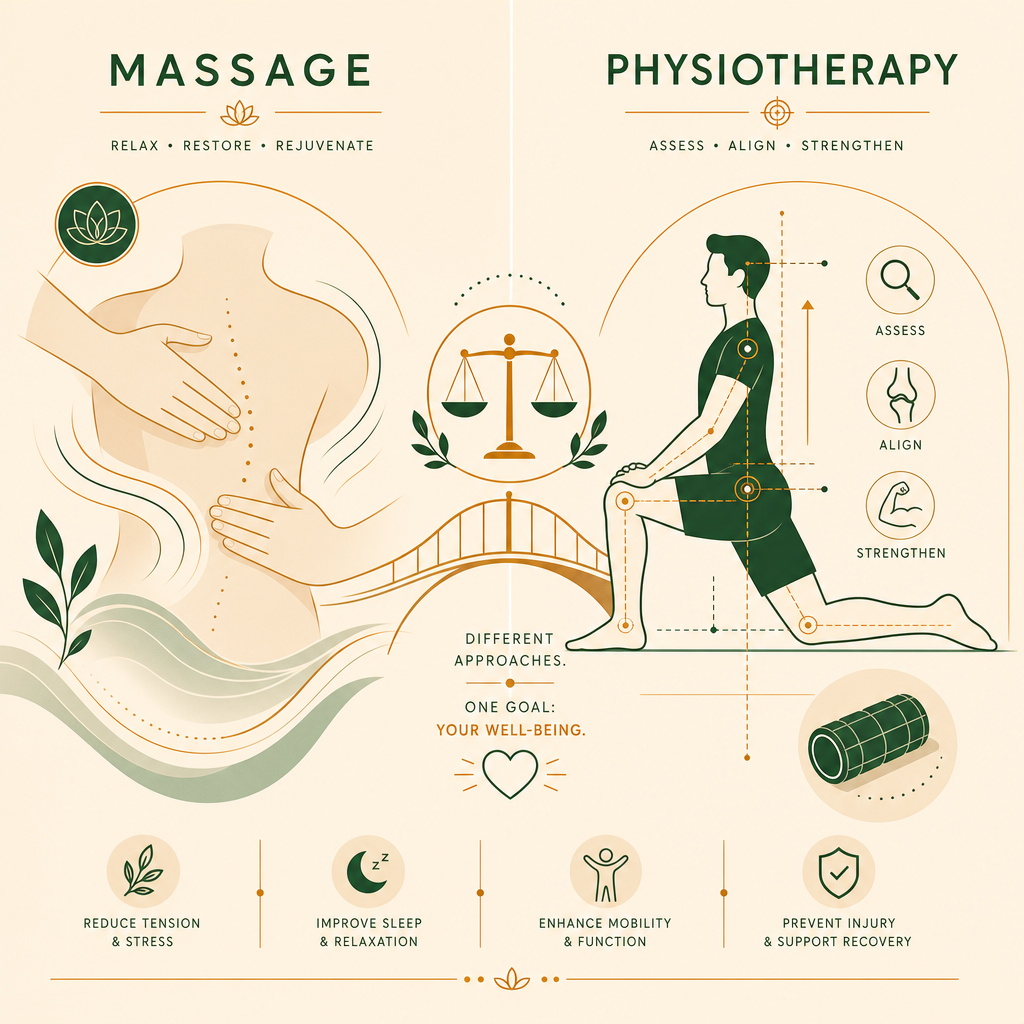
Physiotherapy (Physical Therapy)
Physiotherapy is a clinical, evidence-based healthcare profession. Physiotherapists are university-trained medical professionals who diagnose physical abnormalities, restore function, and prevent disability. They work with:
- Post-surgical rehabilitation (knee replacements, rotator cuff repairs, etc.)
- Neurological conditions (stroke recovery, Parkinson's, spinal cord injuries)
- Sports injuries requiring structured rehabilitation programs
- Chronic conditions like arthritis, osteoporosis, and balance disorders
- Movement pattern analysis and correction
A physio will assess your gait, test your range of motion, evaluate muscle strength, and create a structured plan of exercises and modalities (ultrasound, heat/cold therapy, electrical stimulation) to restore your function.
Massage Therapy
Massage therapy is a manual therapy focused on the soft tissues of the body — muscles, tendons, ligaments, and fascia. While increasingly evidence-based, massage therapy is typically not diagnostic in the medical sense. Massage therapists work with:
- Muscle tension and trigger points
- Stress-related physical symptoms
- Circulation and lymphatic flow
- Chronic tension patterns from posture or repetitive movement
- General relaxation and wellness maintenance
The scope of practice varies by country and state. In many places, massage therapists cannot diagnose conditions, prescribe exercises, or treat open wounds.
The Core Differences at a Glance
| Aspect | Physiotherapy | Massage Therapy |
|---|---|---|
| Primary focus | Restoring function and movement | Soft tissue relaxation and release |
| Training | University degree (BSc/MSc), clinical rotations | Diploma or certificate program (varies) |
| Diagnostic authority | Can diagnose and prescribe treatment | Generally cannot diagnose (varies by region) |
| Main tools | Exercises, manual therapy, modalities, education | Manual techniques (strokes, pressure, stretching) |
| Best for | Injury rehab, post-surgery, neurological conditions | Stress relief, muscle tension, relaxation |
| Insurance coverage | Widely covered by health insurance | Coverage varies (often requires a prescription) |
When Massage Is the Better Choice
There are plenty of situations where massage is actually the superior option — not a replacement, but genuinely more appropriate for the problem at hand.
Stress-Related Muscle Tension
When your shoulders are up around your ears from a high-pressure job, massage is unmatched. The hands-on approach of a skilled therapist can release muscle tension that no exercise can touch. Physiotherapy exercises might strengthen surrounding muscles, but they won't directly release the holding pattern in your trapezius.
Chronic Non-Specific Lower Back Pain
The research is compelling here. A major study published in the Annals of Internal Medicine found that massage therapy was as effective as other treatments for chronic lower back pain, with some patients needing less medication afterward. For non-specific lower back pain (meaning there's no clear structural cause like a herniated disc), massage is an excellent first-line approach.
General Wellness and Prevention
This is where massage truly shines. Regular massage sessions help maintain muscle health, improve posture awareness, reduce stress hormones, and catch tension patterns before they become chronic problems. It's like brushing your teeth — maintenance that prevents bigger issues down the line.
When Physiotherapy Is the Better Choice
On the flip side, there are clear situations where only physiotherapy will do.
Post-Surgical Rehabilitation
If you've had a knee replacement, rotator cuff repair, or any orthopedic surgery, you need physiotherapy. The structured progression of exercises, the monitoring of range of motion, the gradual loading of healing tissues — none of this falls within a massage therapist's scope of practice. Massage can be a wonderful complement to post-surgical rehab (reducing swelling, calming surrounding muscles), but it cannot replace the rehab program itself.
Neurological Conditions
Stroke recovery, Parkinson's disease, multiple sclerosis — these require specialized neurological physiotherapy. Massage can provide symptom relief (reducing spasticity, improving circulation) but the core rehabilitation must be guided by a physiotherapist with neurological training.
Acute Injuries Requiring Diagnosis
You fell while running and now your knee is swollen. Should you get a massage? Absolutely not — not until a medical professional has assessed you. You could have a torn ligament, a fractured bone, or internal damage. Massage on an acute injury can make things dramatically worse. See a doctor or physiotherapist first, get a proper diagnosis, and then discuss whether massage can help in the recovery phase.
The Magic Happens When They Work Together
Here's the thing that both camps sometimes miss: massage and physiotherapy are not competitors. They are teammates. And when they work together, the results can be remarkable.
Real scenario from Raipur SPA: A client comes in with chronic shoulder pain. His physio diagnosed a rotator cuff imbalance — weak external rotators, tight internal rotators. The physio prescribes exercises to strengthen the weak muscles. Meanwhile, at our spa, we work on releasing the tight internal rotators and pecs through deep tissue massage. The client does his exercises three times a week and gets a massage every ten days. Result? His pain resolves in six weeks — faster than either approach alone would have achieved.
This is the integrated approach I recommend. Use physiotherapy for diagnosis, structural rehabilitation, and exercise prescription. Use massage therapy for soft tissue release, pain management during the rehab process, and stress reduction that supports healing.
What the Experts Actually Say
I've spoken with physiotherapists in Raipur about this, and the ones who are most effective are also the ones who refer clients to massage therapy — and vice versa. The "massage is a waste" attitude typically comes from physios who've only seen bad massage (unsupervised spa work by untrained staff). And the "you don't need physio" attitude comes from massage therapists who overestimate their scope of practice.
The truth is more nuanced. A good physio knows that tight muscles resist stretching and strengthening. A good massage therapist knows that temporarily releasing a muscle won't fix a structural imbalance that needs corrective exercise.
They need each other. And so do you.
How to Choose — A Simple Decision Framework
- Is your pain from a specific injury? Start with a physio or doctor for diagnosis.
- Is your pain vague, stress-related, or muscular? Start with massage therapy.
- Have you had surgery in the last 6 months? Physio is your primary. Massage is a complement.
- Do you sit at a desk 8+ hours a day? Both will help. Start with massage to release the tension, then add physio if you need postural correction.
- Are you preparing for or recovering from a sporting event? Both are valuable. Sports massage before and after, physio for ongoing injury prevention and strength work.
The Cost Consideration
Money matters, and I want to be upfront about it. In Raipur, a physiotherapy session typically costs more than a massage therapy session because of the higher level of training and diagnostic authority involved. Physio sessions also tend to be shorter — 30 to 45 minutes — because the focus is on exercise instruction and modality application rather than hands-on manual work.
Massage sessions at Raipur SPA run from 60 to 90 minutes, giving you more hands-on time per rupee. But here's the catch: the value depends on what you need. If you need a structured rehab program, paying for massage alone won't get you the exercise prescription and progress tracking you need. You'd be spending money on the wrong tool.
On the other hand, if your issue is purely muscular tension — tight shoulders from desk work, stiff neck from poor sleeping posture — a series of massage sessions costs significantly less than physio visits for the same problem, and you'll likely get better results because massage directly addresses the soft tissue component that's causing your discomfort.
My honest advice: if budget allows, invest in both. A typical rehab plan might involve 2-3 physio visits for diagnosis, exercise prescription, and progress monitoring, combined with 4-6 massage sessions spaced across the same period for hands-on soft tissue work. The combined approach costs more upfront but typically reduces the total number of sessions needed for full recovery.
Client Scenarios: Which Path Would I Recommend?
Let me walk you through some real scenarios I've encountered at Raipur SPA to help you see how this decision plays out in practice.
Scenario 1: The Desk Worker with Neck Pain
Ravi works at a BPO in Raipur. Twelve-hour shifts, staring at a screen, phone cradled between ear and shoulder. He comes in with neck pain that's been building for six months. His range of motion is limited, and he gets headaches by mid-afternoon.
My recommendation: Start with massage. Ravi's problem is almost certainly muscular — tight upper traps, levator scapulae, and scalenes from prolonged poor posture. A series of deep tissue sessions at Raipur SPA will release these muscles, improve blood flow, and reduce his headache frequency dramatically. He can add physio later if postural correction exercises are needed, but in 80% of cases like his, massage alone resolves the issue.
Scenario 2: The Runner with Knee Pain
Sunita is an amateur marathon runner training for the Raipur half-marathon. She developed knee pain that gets worse with distance. She's tried resting and it comes back as soon as she starts running again.
My recommendation: Start with a physiotherapist. Running-related knee pain can be caused by dozens of factors — IT band syndrome, patellofemoral pain, meniscus issues, even hip weakness that manifests as knee pain. Sunita needs a proper biomechanical assessment and diagnosis. Once her physio identifies the root cause, she can then see us at Raipur SPA for complementary massage work — releasing tight quads and IT bands, and addressing any muscular imbalances the physio identifies.
Scenario 3: The New Mother with Lower Back Pain
Kavita had a baby six months ago and has been dealing with persistent lower back pain ever since. She attributes it to carrying her baby, poor sleep posture, and the general physical toll of new motherhood.
My recommendation: Both, but start with a physiotherapist. Postpartum back pain can involve diastasis recti (abdominal separation), weakened pelvic floor, and significant postural changes from pregnancy and breastfeeding. These require a physiotherapist's assessment and a targeted rehab plan. Once that's in place, massage at Raipur SPA can release the compensating tightness in her back, shoulders, and hips that have developed around the core weakness. The combination is powerful — physio builds the foundation, massage relieves the symptoms.
When Massage and Physio Overlap — A Grey Area Worth Understanding
There's a growing area where the lines between massage therapy and physiotherapy blur. Manual therapy techniques — joint mobilizations, soft tissue release, myofascial release — are used by both professions. Many physiotherapists incorporate massage-like manual techniques into their sessions. And an increasing number of massage therapists are pursuing additional training in clinical assessment, kinesiology taping, and corrective exercise.
So yes, there is overlap. But the key difference remains: a physiotherapist has the training to diagnose, prescribe, and manage a rehabilitation program from start to finish. A massage therapist focuses on the manual component — preparing the tissues for recovery, managing pain, and supporting the process. Even in the grey area, the scope distinction is important.
At Raipur SPA, if a massage therapist has special training that allows them to do more within their scope, we'll tell you. But we'll also be clear about our limits. An honest therapist is worth more than a stretching one.
A Note for Raipur Residents
If you're in Raipur and dealing with any kind of musculoskeletal issue, you're in luck. At Raipur SPA in Samta Colony near Agrasen Chowk, we work closely with physiotherapists in the area. We know when to refer out, and we know how to receive clients who are already under physio care.
Our approach is simple: we'll listen to your history, understand your goals, and be honest with you about whether massage is the right tool for the job. Sometimes it is. Sometimes it's part of the solution. Rarely is it the whole answer on its own.
The Bottom Line
Can massage replace physiotherapy? No. And that's not a failure of massage — it's a recognition that different problems need different tools. A hammer is great for nails but terrible for screws. Both tools are valuable, but they serve different purposes.
Think of physiotherapy as the architect who designs the rehabilitation plan and oversees the structural work. Massage therapy is the craftsman who prepares the materials — releasing tension, improving blood flow, creating the conditions for healing.
You need both, working together, to build a healthy body.
Visit Raipur SPA at Samta Colony near Agrasen Chowk, Raipur. Whether you're recovering from an injury or just trying to manage the stress of daily life, we'll help you figure out the best path forward. Call us or book online at raipurspa.com.
People Also Ask
Related Articles
Wellness Guides, Pricing & FAQs
Massage for Anxiety: How Touch Therapy Calms Your Nervous System
12 min read · 12 May 2026

Wellness Guides, Pricing & FAQs
Burnout Recovery: A Complete Self-Care Plan for Overworked Professionals
10 min read · 12 May 2026

Wellness Guides, Pricing & FAQs
Sleep Better Tonight: Evening Massage Routine for Deep Sleep
11 min read · 12 May 2026
Enjoyed This Article?
Stop reading about relaxation — come experience it firsthand at Raipur SPA.