North-East Indian Massage Traditions: A Cultural Deep Dive

When most people think of Indian massage, they think of Ayurveda — the classical system of medicine that originated in Kerala, in the south. And that's valid. Ayurveda has given the world incredible healing traditions. But it's not the whole story. India is a vast country with diverse indigenous healing practices, and some of the most fascinating and effective traditions come from the North-Eastern states — a region that's often overlooked in the wellness conversation.
I first encountered North-Eastern massage traditions when I trained under a therapist from Nagaland. Her approach to bodywork was fundamentally different from anything I'd learned before. It was more dynamic, more intuitive, more rooted in the rhythms of daily life rather than clinical protocols. It made me curious. So I started studying the traditional healing practices of the seven sisters — Assam, Arunachal Pradesh, Nagaland, Manipur, Meghalaya, Mizoram, Tripura — and Sikkim, the brother state.
What I found was a treasure trove of wisdom that deserves far more attention than it gets. This article is my attempt to do it justice.
The Cultural Context: Why North-East Bodywork Is Different
To understand North-Eastern massage traditions, you need to understand the region. The North-East is one of the most biodiverse places on earth, with some of the highest rainfall, densest forests, and most varied terrain in India. The people here have lived close to nature for millennia, and their healing practices reflect that intimacy.
The region is also home to over 200 distinct ethnic groups, each with its own language, customs, and healing traditions. Unlike the pan-Indian Ayurvedic system, which was codified in Sanskrit texts thousands of years ago, North-Eastern traditions are primarily oral — passed down through generations by word of mouth and hands-on teaching. This makes them more fluid, more varied, and unfortunately, more vulnerable to being lost.
Another key difference: North-Eastern massage traditions are not typically "spa treatments." They're integrated into daily life. In many communities, massage is something mothers do for their children, elders do for the sick, and community members do for each other. It's not a luxury — it's a form of healthcare.
Traditional Massage Practices by State
Assam: The Joon Jua Tradition
In Assam, traditional massage is called "Joon Jua" or "Tel Makh" (oil massage). It's deeply embedded in Assamese culture. New mothers receive daily massages for 30-45 days after childbirth — a practice called "Garcuri" or "Sewali." This is not a luxury; it's considered essential for postpartum recovery.
The oil used is typically mustard oil, often infused with local herbs like "pudina" (mint), "jaluk" (a local herb), and sometimes turmeric. The strokes are vigorous and stimulating — quite different from the gentle, nurturing touch you might expect in a spa environment.
Assamese massage also places a strong emphasis on the feet. In a culture where walking is central to daily life (many rural communities still walk miles daily), foot massage — "Bhar" — is a daily ritual for many families. It's common for younger family members to massage the feet of elders as a sign of respect and care.
Interestingly, Assamese massage also includes a technique called "Gathi" — a form of acupressure using the knuckles and elbows. It's intense, effective, and not for the faint of heart. But it's incredibly effective for deep-seated muscle tension.
Nagaland: The Angami Massage
Nagaland's massage traditions are closely tied to the warrior culture of its tribes. The Angami Naga tribe, in particular, developed a form of bodywork that's both therapeutic and practical.
Traditional Naga massage uses a combination of long, sweeping strokes and percussive techniques. The therapist might use their palms, fingers, knuckles, and even their forearms in a flowing sequence that alternates between broad pressure and targeted point work.
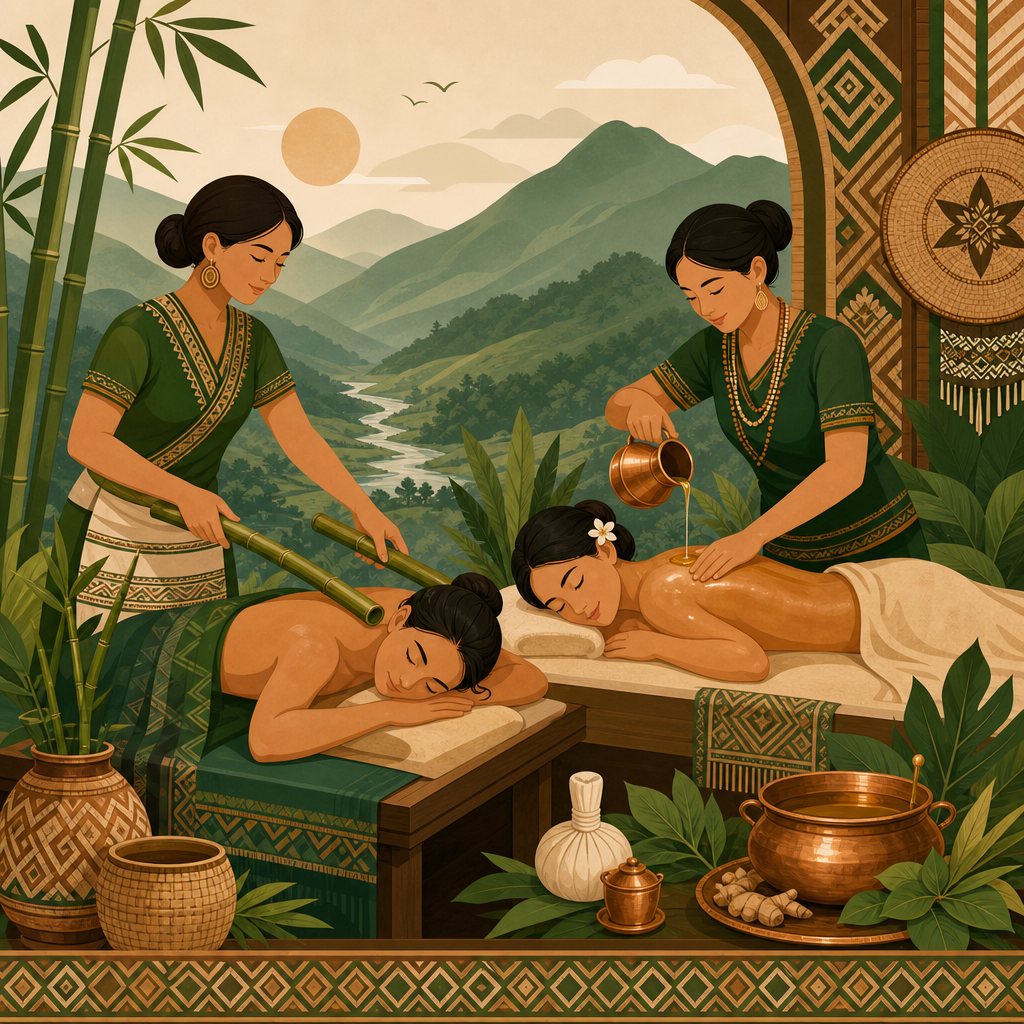
One distinctive feature is the use of heated banana leaves. In traditional practice, banana leaves are warmed over a fire and applied to the body after massage to draw out toxins and soothe sore muscles. It's a beautiful example of using locally available materials for healing.
The oil of choice in Nagaland is sesame oil, often infused with ginger and local herbs. Ginger is a central ingredient in Naga cuisine and medicine — it's warming, anti-inflammatory, and effective for muscle pain.
Meghalaya: The Khasi Herbal Massage
The Khasi people of Meghalaya have a matrilineal society, and many of their healing traditions are passed through the female line. Khasi massage is known for its use of local herbs — there are over 200 species of medicinal plants in Meghalaya, and traditional healers (known as "Nong Pynshit") are experts at selecting and combining them.
Khasi massage typically uses a blend of oils infused with local plants like "Jamyrdoh" (a local fern used for joint pain) and "Sohiong" (a local fruit with anti-inflammatory properties). The massage itself is methodical — the therapist works through each muscle group systematically, using firm pressure and deliberate, unhurried strokes.
A unique aspect of Khasi tradition is the use of "Umshi" — steam therapy combined with massage. Traditional steam baths using local herbs are followed by a thorough massage. This combination of heat and pressure is incredibly effective for detoxification and muscle recovery.
Arunachal Pradesh: Monpa Healing Touch
The Monpa tribe of Arunachal Pradesh, who live in the high-altitude regions near the Tibetan border, have a massage tradition that shows clear influence from Tibetan medicine. It's gentler and more energy-focused than the vigorous styles of the neighboring states.
Monpa massage involves long, gentle strokes combined with breath awareness. The therapist might ask you to breathe in a specific pattern as they work on different areas. The emphasis is on moving "prana" (life force) through the body rather than manipulating muscles mechanically.
The oils used are typically butter-based — yak butter in traditional settings, or ghee in more accessible adaptations. These fats absorb differently into the skin than plant oils, providing deep, sustained nourishment.
Manipur: Meitei Physical Therapy
Manipur's traditional massage, practiced by the Meitei community, is among the most systematically developed in the North-East. It's closely tied to the indigenous religion of Sanamahism, and many of the techniques are believed to have spiritual as well as physical effects.
Meitei massage is rigorous and structured. It involves specific sequences that are followed in order, much like a martial arts form. There are techniques for each major joint, for the spine, and for the internal organs through abdominal work.
One distinctive practice is "Yothen" — a form of therapeutic stretching that's integrated into the massage. The therapist moves your limbs through specific ranges of motion, applying traction and gentle pressure at the end ranges to release joint restrictions.
The oil typically used is mustard or coconut oil, often infused with "Yensil" (a local aromatic herb) and turmeric.
Common Threads Across North-Eastern Massage Traditions
Despite the diversity, some common themes emerge when you study the North-Eastern traditions as a whole:
1. Emphasis on Oil
Every tradition uses oil, and the choice of oil matters enormously. Unlike commercial spa oils that are chosen for their scent or "luxury" feel, North-Eastern oils are chosen for their therapeutic properties. Mustard, sesame, coconut, and mustard-seed oils are common, often infused with locally available herbs.
2. Whole-Body Approach
North-Eastern massage rarely focuses on just one area. Even if you come in with a specific complaint, the therapist will typically work your entire body. The philosophy is that tension in one area affects every other area, and true healing requires addressing the whole system.
3. Rhythmic, Dynamic Movement
Compared to the slow, sustained holds of Western deep tissue or the precise point work of Thai massage, North-Eastern massage is rhythmic and flowing. Therapists often work in sequences that feel like a dance — a continuous, connected series of strokes that maintains momentum throughout the session.
4. Community-Centered Practice
Massage in the North-East is not a commercial transaction between a provider and a client. It's a communal practice — something done within families and communities. This gives it a different energy. The therapist cares about you not as a customer but as a member of their extended community.
5. Use of Local Materials
Banana leaves, bamboo steamers, clay pots, local herbs — North-Eastern traditions make brilliant use of locally available materials. This is practical (they don't rely on imports or complex manufacturing), but it also means the treatments are deeply connected to the land.
Why North-Eastern Massage Matters for Modern Wellness
You might be wondering why, as someone living in Raipur, you should care about massage traditions from states that are thousands of kilometers away. Here's my answer:
The modern wellness industry has become increasingly homogenous. Whether you're in New York, London, Dubai, or Mumbai, you can get essentially the same "spa experience" — the same scented oils, the same ambient music, the same Swedish techniques. There's nothing wrong with that, but we lose something when all of our healing practices come from the same few sources.
North-Eastern massage traditions offer something genuinely different. They're more dynamic, more grounded, and more connected to the natural world. They remind us that healing is not just about technique — it's about relationship, community, and the wisdom that comes from living close to the earth.
At Meraki Spa, we've been inspired by these traditions. While we don't claim to replicate them authentically (that would require the specific local knowledge and materials of each region), we incorporate some of their principles into our practice:
- We use herb-infused oils that honor the tradition of therapeutic blending
- Our sessions are whole-body, even when you come in with a specific complaint
- We train our therapists in rhythmic, flowing sequences inspired by North-Eastern styles
- We emphasize a warm, familial approach rather than a clinical, transactional one
The Challenge of Preserving These Traditions
I want to be honest about a difficult reality: many of these traditions are at risk of being lost. The younger generation in the North-East, like young people everywhere, is moving to cities, adopting global lifestyles, and not always learning the healing practices of their grandparents.
Traditional healers are aging, and there aren't enough young people taking their place. The oral tradition means that when a healer passes away, their knowledge can disappear entirely. There are efforts underway to document these practices — organizations like the North Eastern Development and Documentation Centre have been working on this — but it's a race against time.
I believe that sharing and celebrating these traditions is one way to help preserve them. When people know that a practice exists and understand its value, they're more likely to seek it out, support it, and pass it on. That's part of why I'm writing this article — not to appropriate or commercialize North-Eastern traditions, but to shine a light on them and encourage respect for their depth and wisdom.
How to Experience Authentic North-Eastern Massage
If you're curious about experiencing North-Eastern massage traditions, here are some options:
- Visit the North-East: There's no substitute for experiencing these traditions in their original context. Travel to the region and seek out local practitioners. The best way to find them is through local connections — ask at guesthouses, homestays, or community centers.
- Seek out NE therapists in other cities: Many therapists from the North-East now practice in cities like Delhi, Bangalore, and Mumbai. If you find one, ask about their traditional training. Many are happy to share.
- Try our adapted treatments at Meraki Spa: While we don't claim to offer authentic North-Eastern massage, we've incorporated elements of these traditions into our practice. Our therapists are trained in rhythmic, flowing techniques and we use herb-infused oils. Come by near Samta Colony and try it for yourself.
Final Thoughts: A Tradition Worth Knowing
The North-Eastern massage traditions are a testament to the wisdom of India's indigenous communities. They're practical, effective, and deeply connected to the land and culture that produced them. They deserve to be known, respected, and preserved — not as exotic curiosities, but as legitimate systems of healing that have served communities for generations.
If you're in Raipur and you're curious about bodywork that goes beyond the standard spa menu, come to Meraki Spa. We're near Samta Colony, just off Agrasen Chowk. We'll share what we know — and we'll keep learning, always, from the rich traditions that make Indian bodywork so incredibly diverse.
People Also Ask
Related Articles
Ayurvedic & Traditional Indian Therapies
Abhyanga: The Ancient Ayurvedic Self-Massage You Can Learn
10 min read · 12 May 2026
Ayurvedic & Traditional Indian Therapies
Shirodhara Experience: What to Expect in Your First Session
10 min read · 12 May 2026
Ayurvedic & Traditional Indian Therapies
Ayurvedic Body Types: Which Massage Oil Is Right for Your Dosha?
11 min read · 12 May 2026
Enjoyed This Article?
Stop reading about relaxation — come experience it firsthand at Raipur SPA.