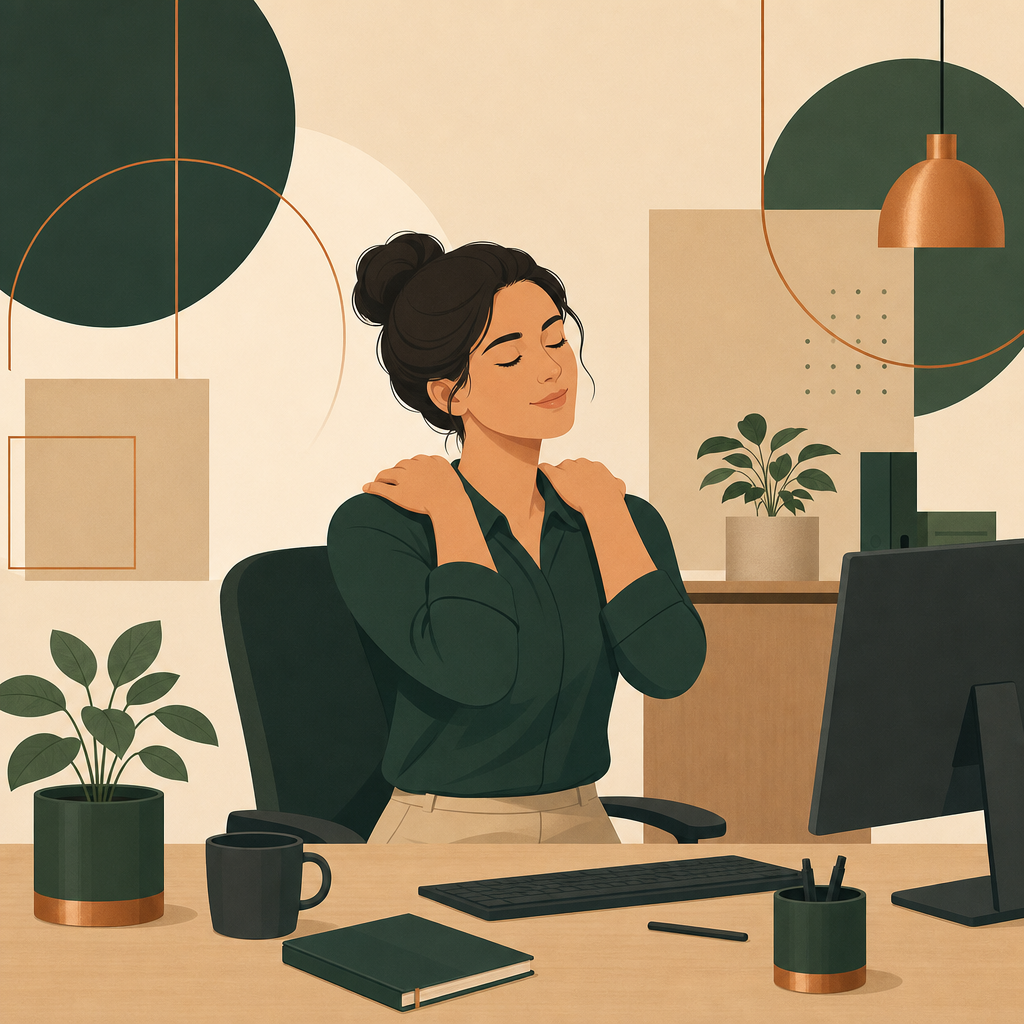
5-Minute Self-Massage Techniques for Instant Stress Relief at Work
Let's be honest with each other. You're not going to do a full yoga sequence in the middle of your workday. You're not going to meditate for twenty minutes when your inbox is overflowing. And you're definitely not going to leave the office for a spa session every time your shoulders tighten up — even though a visit to Raipur SPA in Samta Colony near Agrasen Chowk would fix most of what's bothering you in an hour.
But here's what you can do: spend five minutes giving yourself a targeted self-massage at your desk. Not a half-hearted shoulder rub, but a real, technique-based intervention that releases tension, improves circulation, and resets your nervous system. I'm going to show you exactly how.
These techniques are based on the same principles that professional massage therapists at Raipur SPA use — trigger point therapy, acupressure, and myofascial release — adapted so you can perform them on yourself without any special equipment. You don't need a massage table, expensive oils, or an hour of free time. You need your own hands, a few minutes, and the willingness to actually try this the right way.
Why Self-Massage Works — The Science in 30 Seconds
Self-massage works through several mechanisms. First, mechanical pressure on tight muscles triggers a neurological response called the "gate control theory" — essentially, the pressure signal from your hands competes with the pain signal from your tight muscles, and the brain prioritizes the pressure signal, reducing your perception of pain. Second, sustained pressure on trigger points (those hard knots in your muscles) interrupts the cycle of muscle spasm and reduces local ischemia (lack of blood flow). Third, the act of deliberately focusing on a tense area sends a signal to your parasympathetic nervous system that it's okay to relax.
In plain English: pressing on a knot makes it go away, and the mental focus required to do it deliberately calms your entire stress response system. Five minutes of proper self-massage is more effective than thirty minutes of worrying about the tension in your shoulders.
Before You Start: The Golden Rules of Self-Massage
- Breathe. The single biggest mistake people make with self-massage is holding their breath while pressing on a tender spot. You need to breathe deeply into the pressure — inhale as you apply pressure, exhale as you release. This prevents your body from tensing up against your own hands.
- Pressure should be "good hurt." You're looking for the sensation of productive discomfort — it should feel like a strong stretch, not like an injury. If you're wincing or bracing against the pressure, back off. The target is about a 6 or 7 on a 1-to-10 discomfort scale.
- 30 seconds minimum. Trigger points need sustained pressure to release. Quick stabs or pokes do nothing. You need to hold steady pressure for at least 30 seconds — and ideally 60 to 90 seconds — per spot. Set a mental timer.
- Stay hydrated. Self-massage releases the same metabolic waste products that professional massage does. Drink water before and after your session.
The 5-Minute Self-Massage Routine
This routine is designed for maximum impact in minimum time. Do each step for approximately 60 seconds. The whole thing takes exactly 5 minutes. You can do it in your chair, in your clothes, without anyone even noticing if you're subtle about it.
1. Suboccipital Release — The Headache Eraser (60 seconds)
Target: The muscles at the base of your skull, just below the bony ridge.
Why: These small muscles, the suboccipitals, are among the tightest muscles in the modern human body. They're constantly contracted to stabilize your head when it's forward of your shoulders (which it is, right now, unless you corrected your posture after reading that sentence). Tight suboccipitals are the primary cause of tension headaches — possibly the most common health complaint among office workers.
How: Interlace your fingers behind your head, with your thumbs resting on the base of your skull, one on each side of your spine. Press your thumbs into the soft tissue just below the skull ridge — you should feel a small indentation. Apply firm, steady pressure and make tiny circular movements. Don't press on your spine itself — stay on the muscle tissue on either side. You'll know you've found the right spot because it will feel tender and releasing the pressure will create a sensation of warmth or tingling that spreads through your head. Breathe deeply and hold for a full 60 seconds. This technique alone can eliminate an oncoming tension headache in under two minutes.
2. Upper Trap Pinch and Release — The Knot Melter (60 seconds)
Target: The thick muscle running from the top of your shoulder to the base of your neck — the upper trapezius.
Why: The upper traps are the "stress muscles." They're the ones that hike up toward your ears when you're anxious, frustrated, or concentrating intensely. Most people carry so much chronic tension in their upper traps that they can't feel the muscle anymore — it's just a permanent state of tightness they've normalized.
How: Reach across with your opposite hand. For the right upper trap, use your left hand. Grip the muscle between your thumb and fingers — you're essentially pinching the ridge of muscle on top of your shoulder. Squeeze firmly and hold. You should feel the muscle belly between your fingers. If you can't grab enough tissue, your traps are too tight and you need to relax your shoulder down first. Once you have a good grip, squeeze and hold for 30 seconds, then release slowly. Repeat on the other side. You can also add a gentle kneading motion — squeezing, holding, and then releasing like you're testing a fruit for ripeness. This technique helps break the chronic spasm that keeps your shoulders up around your ears.
3. Temple and Jaw Massage — The Face Relaxer (60 seconds)
Target: Your temples (temporalis muscles) and jaw muscles (masseter).
Why: Office workers clench their jaws without realizing it. It's a subconscious response to stress and concentration. This clenching creates tension that radiates up into your temples (causing headaches), down into your neck (causing stiffness), and even affects your teeth (causing grinding and enamel wear). Most people are surprised at how tight their jaw is when they actually check.
How: Place your fingertips on your temples — the soft area just behind and above your eyes. Press gently and make small circles. You should feel a subtle release as the temporalis muscle relaxes. Then, move your fingers down to your jaw — just below your cheekbones, at the angle of your jaw. Clench your teeth once to feel the masseter muscle bulge, then relax. Apply firm pressure to that muscle belly with your fingertips and hold. For the deeper release, try placing two fingers inside your cheek (against your teeth) and your thumb on the outside of your cheek, then squeeze gently. This is called the "intraoral release" and it's incredibly effective for stubborn jaw tension. Breathe through it — yes, it feels odd, but it works.
4. Wrist and Forearm Release — The Typist's Friend (60 seconds)
Target: Your forearm extensors and flexors — the muscles that control your fingers.
Why: If you type for a living, your forearm muscles are working harder than almost any other muscles in your body. The repetitive motion of typing creates chronic tightness in the forearm muscles that can lead to carpal tunnel syndrome, tennis elbow, and persistent wrist pain. The damage is cumulative — it builds over years, not days.
How: Extend your right arm in front of you with your palm facing up. With your left hand, grip the fleshy part of your forearm just below your elbow. Using your thumb, press into the muscle belly and slide slowly toward your wrist. You're essentially doing a mini-myofascial release on your forearm. You'll find tender spots — these are trigger points from hours of typing. When you find one, hold pressure for 20-30 seconds until you feel it release. Then flip your arm over (palm facing down) and repeat on the top of your forearm. This technique can prevent the development of repetitive strain injuries and provides immediate relief for tired, achy wrists.
5. Thoracic Spine Opener — The Posture Corrector (60 seconds)
Target: The muscles along your upper back, between your shoulder blades.
Why: This is the area that most people can't reach but that causes the most visible postural damage. When your chest muscles tighten from reaching forward to type, your upper back muscles — the rhomboids and middle trapezius — become weak and overstretched. This creates the hunched, rounded-shoulder posture that's become an epidemic among office workers.
How: You need a prop for this one — a tennis ball, a lacrosse ball, or even a tightly rolled-up sock works. Place the ball against a wall at upper-back height. Lean back so the ball is between the wall and your upper back, positioned next to your spine (not on it). Bend your knees slightly and roll your body side to side and up and down, letting the ball dig into the tight spots between your shoulder blades. When you find a particularly tender spot, stop and hold steady pressure while taking deep breaths. Move the ball around systematically — you're covering the entire area between your shoulder blades and the inner edges of your shoulder blades. After 60 seconds, stand up straight and pay attention to how much easier it is to hold good posture. The difference is immediate and obvious.
Advanced Techniques (Add These When You Have More Time)
If you occasionally have 10 minutes instead of 5, these techniques will dramatically increase the effectiveness of your self-massage routine. Consider adding one or two of these on days when your stress levels are particularly high.
Acupressure Points for Instant Calm
Acupressure is the practice of applying pressure to specific points on the body to influence energy flow and nervous system activity. While the traditional explanation involves meridians and chi, the modern understanding is that these points are often located at nerve bundles or muscle attachment points that influence systemic tension patterns.
LI4 (Hegu) — The Stress Relief Point: Located in the webbing between your thumb and index finger. Squeeze this point firmly with your other thumb and hold for 30 seconds. It's used in traditional Chinese medicine for stress, headache, and facial pain. It's also the go-to point for many acupuncturists for general stress relief. Apply pressure on both hands.
GB20 (Fengchi) — The Headache Point: Located in the hollows at the base of your skull, just behind the bony bumps behind your ears. Press into these hollows with your thumbs, angling upward toward the center of your skull. Hold for 30 seconds while breathing deeply. This point is exceptionally effective for tension headaches, neck stiffness, and even eyestrain — all of which are chronic problems for office workers.
PC6 (Neiguan) — The Nausea and Anxiety Point: Located about three finger-widths below your wrist crease on the inner forearm, between the two tendons. Press firmly with your thumb and hold. This point is well-studied for reducing nausea and has a calming effect on the nervous system. It's particularly useful before important meetings or high-stress presentations.
Self-Massage With Household Items
You don't need specialized equipment to get professional-quality self-massage. Here are some items you can use from your desk or home:
- Water bottle: A full water bottle makes an excellent massage tool for your legs, glutes, and feet. Roll it under your thighs while sitting to release quadriceps tension.
- Pen or marker: The capped end of a pen is perfect for targeting specific trigger points in your forearms and hands. Press the cap into tender spots and hold.
- Chair back: The edge of your chair back is perfect for digging into your glutes and the sides of your hips. Just lean against it and let your bodyweight do the work.
- Book stack: A stack of books under your hands while sitting can provide a gentle stretch for your forearms and wrists between typing sessions.
- Rolled-up towel: Place it behind your upper back while lying down for a gentle thoracic extension. This counteracts the forward hunch of desk work.
When to Use These Techniques Throughout Your Day
Timing matters. Here's when each technique is most effective:
- Mid-morning (around 10:30-11 AM): The suboccipital release and temple massage. This is when tension headaches often start building. Catching it early prevents the headache from fully developing.
- Post-lunch (around 2-3 PM): The upper trap release and thoracic spine opener. Sitting after a meal exacerbates poor posture, and this is the peak time for midday slumping.
- Pre-meeting (5 minutes before a big call or presentation): The acupressure points (LI4 and GB20) and deep breathing. This combination reduces performance anxiety and calms your nervous system.
- End of day (before leaving work): Full 5-minute routine. This helps you transition out of work mode and prevents you from carrying work tension home.
- During long work sessions (every 90 minutes): Just the wrist and forearm release. This prevents repetitive strain from accumulating over the course of a long day.
When Self-Massage Is Not Enough
Self-massage is powerful, but it's not a replacement for professional treatment. There are limits to what you can do to your own body. You can't effectively work on your own lower back. You can't stretch your own hamstrings properly. And you certainly can't access the deep layers of muscle that a trained therapist can reach.
Use these techniques as daily maintenance — think of them as brushing your teeth. But schedule professional massages as your regular deep cleaning. At Raipur SPA in Samta Colony near Agrasen Chowk, we work with clients who use self-massage between sessions and consistently report better results than those who don't. The combination of daily self-care and professional treatment is the most effective approach for long-term health.
If you find that you need these self-massage techniques multiple times every day to feel normal, that's a sign that you're overdue for a professional session. Your body is telling you that the tension has built beyond what self-care can manage.
Final Word
You have the ability to change how you feel in five minutes. Not tomorrow, not next week — right now, at your desk, as you read this. Put down your phone or close your laptop, find those suboccipital muscles at the base of your skull, and spend one minute pressing into them with steady, deliberate pressure. Breathe deeply while you do it.
Notice how different your head feels when you're done. That's the power of informed self-massage — it's immediate, effective, and always available. Make it a habit. Combine it with monthly professional sessions at Raipur SPA in Samta Colony. Your body will thank you — not just in the moment, but in the cumulative relief of months and years of consistent care.
Five minutes. Every day. It's the smallest investment with the biggest return.
People Also Ask
Related Articles
Wellness Guides, Pricing & FAQs
Massage for Anxiety: How Touch Therapy Calms Your Nervous System
12 min read · 12 May 2026

Wellness Guides, Pricing & FAQs
Burnout Recovery: A Complete Self-Care Plan for Overworked Professionals
10 min read · 12 May 2026

Wellness Guides, Pricing & FAQs
Sleep Better Tonight: Evening Massage Routine for Deep Sleep
11 min read · 12 May 2026
Enjoyed This Article?
Stop reading about relaxation — come experience it firsthand at Raipur SPA.