Knee Pain After Running: Massage Therapy for Knee Recovery
I remember the first time I dealt with runner's knee professionally. A guy named Arjun came into Raipur SPA — he'd been training for his first half marathon and was about six weeks in when the pain started. Just a twinge at first, on the outside of his right knee, around the four-kilometer mark. He'd slow down, it would ease up, he'd speed up, it would come back. Classic pattern.
By the time he walked into our clinic in Samta Colony, he couldn't run two kilometers without significant discomfort. He was frustrated, demoralized, and convinced his running days were over. He'd already spent a month "resting" — which, for the record, did nothing — and was starting to think he'd need surgery.
Spoiler: he didn't need surgery. He needed his IT band released, his quads balanced, and a better understanding of why his knee was hurting in the first place. Within three sessions, he was running pain-free. He finished that half marathon.
I'm telling you this because knee pain after running is one of the most treatable problems I encounter at Raipur SPA. And most runners are getting the wrong advice.
Why Your Knee Hurts After Running
The knee is a hinge joint. Its job, mechanically speaking, is pretty simple: bend and straighten. But it's at the mercy of the muscles above it (the quads and hamstrings) and below it (the calves). When those muscles are tight, weak, or imbalanced, the knee pays the price.
Here's the thing most runners don't realize: your knee pain is almost never a knee problem. It's a muscle imbalance problem that happens to show up at the knee. Treat the knee itself — ice, rest, anti-inflammatories — and you're treating the symptom. Treat the muscles that control the knee, and you fix the root cause.
Runner's Knee (Patellofemoral Pain Syndrome)
This is the most common running injury, full stop. It's pain around or behind the kneecap, usually felt during or after running, squatting, or going downstairs. What's happening mechanically: your kneecap isn't tracking properly in its groove. Tight outer quads (vastus lateralis) are pulling the kneecap outward, while weak inner quads (vastus medialis) can't counterbalance that pull. Result: friction, inflammation, pain.
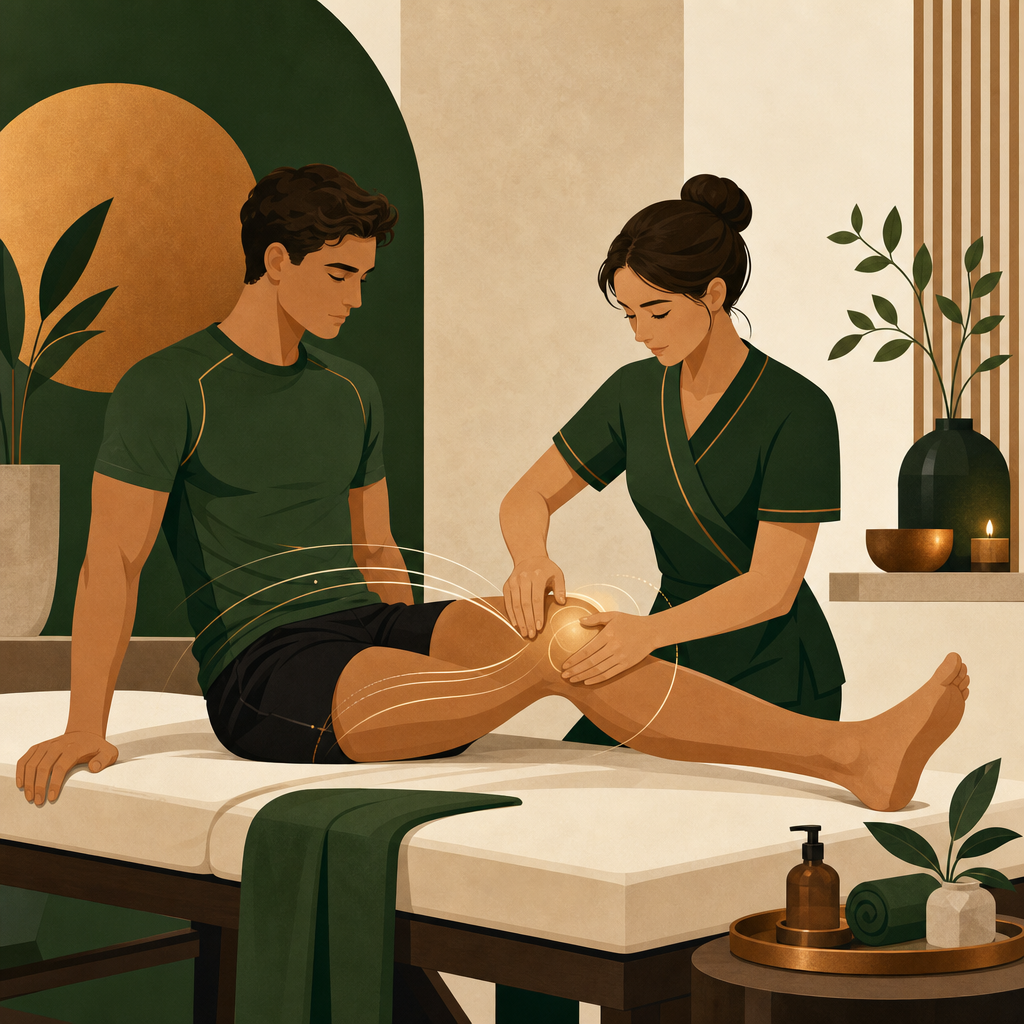
Massage directly addresses this imbalance. By releasing the tight vastus lateralis — the big outer quad muscle — and activating the vastus medialis through specific techniques, we can change the tracking of the kneecap. It's not theory. I've seen it happen on the table in real time.
IT Band Syndrome
The iliotibial band is a thick band of fascia running from your hip to the outside of your knee. It's supposed to glide smoothly over the bony bump on the outside of your knee (the lateral femoral condyle). But when it gets tight — and it gets tight from running, especially on cambered roads or always in the same direction — it doesn't glide. It snaps. And then it hurts.
IT band syndrome is notoriously stubborn because the IT band itself doesn't stretch much. It's fascia, not muscle. So foam rolling it directly? That hurts and doesn't accomplish much. The key is releasing the muscles that attach to it — the tensor fasciae latae (TFL), the glute max, and the glute medius. When those muscles relax, the tension on the IT band drops dramatically.
I use a specific sequence for IT band work at Raipur SPA: release the TFL, release the glutes, then work the IT band itself with gentle cross-fiber friction. Most people feel a noticeable difference after the first session.
Patellar Tendinopathy
Pain right below the kneecap, at the patellar tendon. Common in runners who've increased their mileage too quickly or added hill training without proper adaptation. The tendon gets overloaded, develops micro-tears, and becomes painful to load.
The research is pretty clear that heavy slow resistance training is the gold standard for this, but massage plays an important supporting role. By releasing the quads — which are almost always tight when the patellar tendon is under stress — we reduce the resting tension on the tendon. Less resting tension means less pain, which means better rehab outcomes.
What a Knee Recovery Massage Session Looks Like
When someone comes to Raipur SPA with knee pain, here's my general approach. It changes based on their specific presentation, but this is the framework.
Assessment (First 10 Minutes)
I need to understand what's going on before I touch anything. Where exactly is the pain? Does it move? What makes it better or worse? I also do a quick manual assessment — checking quad tightness, hamstring flexibility, hip mobility, and ankle range of motion. The knee is connected to everything, and sometimes the problem is coming from two joints away.
Quad Release (15-20 Minutes)
I spend significant time on the quads. Most runners have rock-hard quads that they're quite proud of. But tight quads pull on the kneecap through the quadriceps tendon. I use a combination of effleurage (long, gliding strokes), petrissage (kneading), and sustained compression on trigger points. The rectus femoris — the quad muscle that crosses both the hip and knee joints — is almost always a problem area. When it's tight, it limits hip extension and pulls on the kneecap simultaneously. Double trouble.
IT Band and Lateral Release (10-15 Minutes)
I work the TFL and glute medius with sustained pressure and cross-fiber techniques. Then I address the IT band itself, working from hip to knee with the client's knee bent at 90 degrees. This position takes tension off the IT band, allowing deeper, more effective work.
Hamstring and Calf Work (10 Minutes)
Runners often neglect their hamstrings in massage — they focus on quads and calves. But tight hamstrings pull the tibia backward, altering knee mechanics. The calves, especially the gastrocnemius which crosses the knee joint, also play a role. I address both.
Stretching and Movement (5-10 Minutes)
We finish with assisted stretching and some movement patterns to consolidate the release. I also teach my clients specific stretches they can do at home — because the real work happens between sessions.
The Quad-Hamstring Balance
Let me talk about something that doesn't get enough attention: the quadriceps to hamstring strength ratio. In running, the quads are the primary drivers. They extend the knee and propel you forward. The hamstrings, meanwhile, are decelerators — they slow down the lower leg at the end of the swing phase.
In most runners, the quads are significantly stronger and tighter than the hamstrings. This imbalance creates an anterior tilt of the pelvis (tight quads pull the pelvis forward) and puts extra stress on the kneecap. The hamstrings, meanwhile, become lengthened and weak — a terrible combination.
Massage helps by releasing the quads (reducing the pull on the kneecap) and addressing any trigger points in the hamstrings (which can refer pain to the back of the knee). But I always tell my clients: massage alone won't fix the strength imbalance. You need to complement it with targeted strengthening, especially for the hamstrings and glutes.
Self-Care Tips for Runners
Between sessions, here's what I recommend to every runner dealing with knee pain:
- Foam roll your quads, not your IT band. Rolling the IT band directly is painful and ineffective. Roll your quads, your glutes, and your TFL. That's where the real tightness lives.
- Stretch your quads lying on your side, not standing. The standing quad stretch puts your knee in a position that can aggravate patellofemoral issues. Side-lying with a strap is safer and just as effective.
- Strengthen your glutes. Weak glutes make your quads do all the work. Clamshells, glute bridges, and monster walks should be in every runner's routine.
- Check your shoes. Running shoes lose their cushioning after 400-500 miles. Old shoes = more impact = more knee stress.
- Run on softer surfaces. Grass, trails, or a track are kinder to knees than concrete or asphalt. Mix it up.
Cross-Training: Your Knees' Best Friend
One of the best things I tell runners dealing with knee pain is this: running doesn't have to be the only thing you do. In fact, during recovery, it shouldn't be. Cross-training maintains your cardiovascular fitness while giving your knees a break from repetitive impact. Here are the activities I recommend most often:
Cycling — Low Impact, High Reward
Cycling is almost perfect for runners with knee pain. It strengthens the quads and glutes without the pounding of running. The key is proper bike fit — your saddle height should be set so your knee has a slight bend at the bottom of the pedal stroke. Too low and you'll overload the patellar tendon. Too high and you'll strain the hamstrings. A good rule of thumb: when your pedal is at the bottom, your knee should be at about 15-20 degrees of flexion. Spin at a cadence of 80-90 RPM, and avoid pushing big gears — high resistance with low cadence puts more stress on the knee.
Swimming — Full Body Recovery
Water eliminates impact entirely while providing gentle resistance for muscle strengthening. Freestyle and backstroke are excellent for maintaining running fitness. Avoid breaststroke if you have knee pain, though — the frog kick can aggravate the medial knee structures. I had a client who did six weeks of pool running and swimming while recovering from IT band syndrome. She came back to running stronger than before because her glutes and core had gotten significantly stronger in the water.
Elliptical Training
The elliptical machine is underrated for runners. It mimics the running motion without the impact, and you can adjust the incline and resistance to simulate hill running. Use a slight forward lean and actively push through your heels to engage your glutes — many runners just let their legs drag on the elliptical, which doesn't translate well to running mechanics.
Nutrition for Knee Health: What Runners Need to Know
What you eat plays a surprising role in how well your knees handle running. Here's what the research — and our experience at Raipur SPA — tells us:
Omega-3 Fatty Acids
Inflammation is at the root of most running-related knee pain. Omega-3s — found in fatty fish like salmon, mackerel, and sardines, as well as in flaxseeds, chia seeds, and walnuts — have powerful anti-inflammatory effects. Aim for two servings of fatty fish per week, or consider a fish oil supplement (1000-2000 mg daily, with food). I've had clients who noticed a significant reduction in their post-run knee stiffness after incorporating more omega-3s into their diet.
Vitamin D and Calcium
Bone health matters for runners. Your patella (kneecap) is a bone that's embedded in the quadriceps tendon, and it bears enormous force with every stride. Adequate vitamin D (from sunlight and supplements) and calcium (from dairy, leafy greens, or fortified foods) support bone density and help prevent stress reactions. In Raipur, we're lucky to have abundant sunshine, but many people still have low vitamin D because they stay indoors or wear sunscreen consistently. Get your levels checked if you're a long-term runner with persistent knee issues.
Collagen and Vitamin C
Your tendons and ligaments are made of collagen. Supplementing with collagen — specifically type-I collagen in combination with vitamin C — has been shown to support tendon health and reduce the risk of overuse injuries. It's not a magic bullet, but it's one more tool in the toolbox. I recommend taking 10-15 grams of collagen powder with a vitamin C source (a glass of orange juice works perfectly) about 30-60 minutes before a run, when blood flow to the tendons is highest.
Recognizing Early Warning Signs Before Your Knee Shouts
Most runners wait until the pain is significant before they do anything about it. By then, the injury has been developing for weeks or months. Here are the early warning signs I tell my clients to watch for — catch these early, and you can often prevent a full-blown injury:
- Stiffness that goes away after the first KM, then comes back after running — This classic pattern suggests an overuse issue that's in its early stages. The movement seems to warm it up, but the post-run stiffness means the tissue got irritated during the run.
- Changes in your running gait — If someone watching you run says you look different, or if you feel like you're favoring one side, pay attention. Asymmetry is almost always a sign of compensation for a developing issue.
- Pain that's present at rest but goes away once you warm up — This can be misleading because it seems like the movement helps. But what's actually happening is that you're raising your pain threshold, not fixing the underlying issue. The pain will return — often worse — after you cool down.
- Clicking or popping that's accompanied by pain — Many knees click or pop without pain, and that's usually harmless. But when the sound is accompanied by discomfort, it suggests that something is catching or rubbing abnormally.
- Swelling that appears after running — Mild swelling indicates inflammation inside the joint. It doesn't have to be visible — you might just feel a sense of fullness or tightness in the knee after a run. This is your body telling you that the load was too much.
If you notice any of these signs, here's my advice: don't run through it. Take two to three days off, and use that time for massage, gentle stretching, and cross-training. If the symptoms disappear during the break, you caught it early and can resume running carefully. If they persist, you need professional assessment sooner rather than later.
When Can You Run Again?
This is the question every runner asks. The answer depends on the severity and the specific diagnosis, but here's a general guideline I use:
If running hurts from the first step, stop. You're not being tough, you're making things worse. If running is comfortable for the first 10-15 minutes and the pain comes on gradually, you can probably continue at reduced intensity, but you need to address the underlying issue.
I usually recommend a phased return: start with walking, then walk-run intervals, then steady running. Don't increase your weekly mileage by more than 10%. And for the love of good knees, incorporate rest days. Your body repairs and strengthens on rest days, not on running days.
A specific phased return I often prescribe looks like this:
- Week 1-2: No running. Walking only. Use cross-training for cardio. Massage therapy 2-3 times during this period.
- Week 3: Walk-run intervals — 3 minutes walking, 1 minute jogging. Repeat for 20-30 minutes total. Run on soft surfaces only.
- Week 4: Increase to 2 minutes jogging, 2 minutes walking. Total time 25-30 minutes. Add a third massage session if needed.
- Week 5: Continuous easy jogging for 15-20 minutes. No speed work, no hills.
- Week 6: Gradually increase duration. Add gentle hill work if pain-free.
- Week 7 onward: Resume normal training but keep the 10% mileage rule and incorporate one rest day for every two running days.
Arjun, the half-marathon guy I mentioned earlier? He took two full weeks off running after his first massage session. We did two more sessions during that time. By week three, he was doing light jogging. By week six, he was back to full training. He finished his race with no knee pain. That was over a year ago, and he still comes in for maintenance sessions every few weeks.
That's the thing about massage for knee recovery. It's not a quick fix. It's part of a sustainable approach to running that keeps you on the road for years, not just for one season.
Don't let knee pain sideline you. Visit Raipur SPA in Samta Colony for targeted knee recovery massage. Book online at raipurspa.com or call us today.
Keywords: knee pain running, runner's knee massage, knee recovery, sports massage Raipur, IT band release
People Also Ask
Related Articles
Deep Tissue & Pain Relief Massage
Hip Pain Relief: The Massage Techniques That Actually Work
14 min read · 12 May 2026
Deep Tissue & Pain Relief Massage
Hand and Wrist Massage for Gamers, Typists, and Artists
13 min read · 12 May 2026
Deep Tissue & Pain Relief Massage
TMJ Relief: Facial and Jaw Massage for Teeth Grinders
11 min read · 12 May 2026
Enjoyed This Article?
Stop reading about relaxation — come experience it firsthand at Raipur SPA.