TMJ Relief: Facial and Jaw Massage for Teeth Grinders
I'll never forget the first person who came to me for TMJ relief at Raipur SPA. She was a lawyer, mid-thirties, sharp as a tack. She sat down in our consultation room in Samta Colony and said, "I don't know if this is a massage thing, but I've tried everything else."
Everything else meant: a nightguard from her dentist, physical therapy for her neck, Botox in her masseter muscles, acupuncture, meditation apps, and six different pillows. She still woke up every morning with her jaw clenched so tight her temples ached. She'd stopped eating chewy foods. She'd stopped laughing freely because opening her mouth wide hurt. She was tired, cranky, and running out of options.
I told her: yes, this is absolutely a massage thing. And within four sessions, she was sleeping through the night, eating apples again, and laughing without pain.
Let me tell you why jaw massage works for TMJ, and why so few people are getting it.
What TMJ Actually Is
Let's clear up terminology first. TMJ stands for temporomandibular joint — the joint that connects your jawbone (mandible) to your skull (temporal bone). You have two of them, one on each side, and they work together. When people say "I have TMJ," they usually mean TMD — temporomandibular disorder. But the shorthand has stuck, so I'll use TMJ here.
The jaw joint is one of the most complex joints in the body. It's a hinge AND a glide joint — it opens and closes (hinge) and also slides forward and sideways (glide). When you eat a steak, your jaw is moving in multiple planes simultaneously. That complexity means there are many things that can go wrong.
The most common causes I see:
- Bruxism (teeth grinding) — usually at night, often stress-related. The jaw muscles contract forcefully, sometimes with hundreds of pounds of pressure, all night long.
- Clenching — a daytime habit. You hold tension in your jaw without realizing it. Check right now: are your teeth touching? If yes, you might be a clencher. Your resting jaw position should have a small gap between your upper and lower teeth.
- Posture — Forward head posture (which is endemic in phone users) pulls the jaw forward and changes the mechanics of the joint. Your jaw position is intimately tied to your head and neck position.
- Stress — The jaw is a classic place to hold emotional tension. When we're stressed, we clench. When we clench, the muscles get tight. When the muscles get tight, the joint suffers.
Why Traditional Treatments Often Fall Short
Nightguards are the standard first-line treatment for bruxism, and they're useful — they protect your teeth from wear. But they do nothing to reduce the muscle tension that's causing the grinding. You're still clenching all night. You're just clenching on a piece of plastic.
Botox in the masseter muscles works, but it's not a long-term solution. It weakens the muscle temporarily, which reduces the force of clenching. But it doesn't address the underlying tension patterns. Plus, it's expensive and needs to be repeated every three to six months.
Physical therapy helps, but most PTs focus on the neck and posture aspects and don't address the muscles of mastication directly.
Massage fills the gap that all these treatments leave open. It directly releases the hypertonic jaw muscles, it addresses the neck and shoulder tension that contributes to jaw problems, and it teaches your body what relaxation feels like in a part of your body that's been chronically tight.
What TMJ Massage Actually Looks Like
When someone comes to Raipur SPA for TMJ relief, here's what a session looks like:
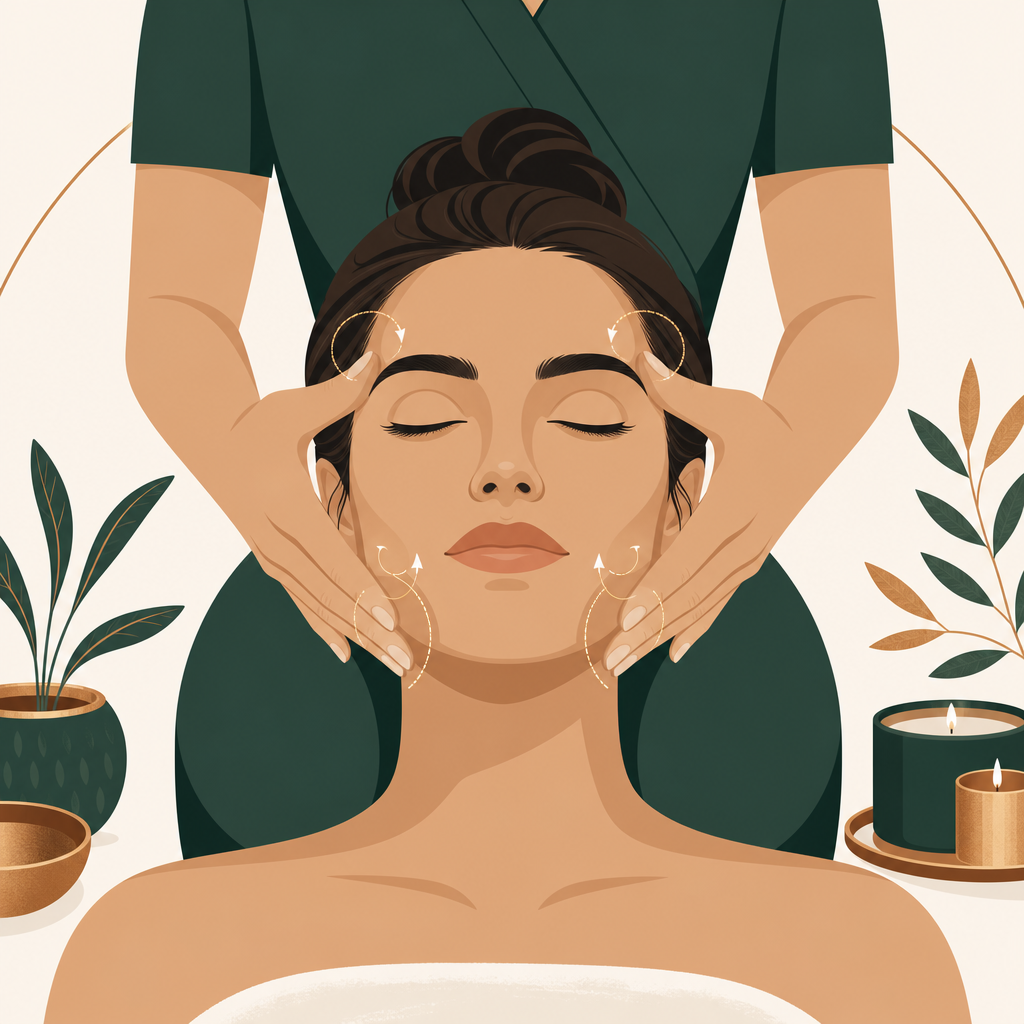
External Jaw Massage (15-20 Minutes)
I start with the muscles you can feel from the outside: the masseter (the big muscle on the side of your jaw that you feel when you clench your teeth), the temporalis (the fan-shaped muscle on the side of your head), and the medial and lateral pterygoids (deeper muscles inside your cheek area).
The masseter is usually the star of the show. In a chronic clencher, this muscle is dense, ropey, and remarkably tender. I use sustained thumb and finger pressure, working the muscle belly from origin to insertion. I'm looking for trigger points — hypersensitive spots in the muscle that refer pain to the teeth, the temple, or behind the eye. I hold each point for 30-60 seconds until I feel the muscle release.
The temporalis is next. I work it in a fan pattern from the temple area down to the jaw. This muscle can refer pain to the upper teeth and cause tension headaches. Releasing it often brings immediate relief to people who've had chronic headaches they didn't even connect to their jaw.
Intraoral Massage (10-15 Minutes)
This is the part that surprises people, but it's incredibly effective. I wear gloves, and I work inside the mouth — specifically on the masseter (from the inside of the cheek), the pterygoids (behind the last upper molar), and the temporalis tendon (where it attaches inside the mouth).
I know — having someone's fingers in your mouth sounds unpleasant. But the release is profound. These muscles are almost never accessed externally in a meaningful way. Releasing them from the inside gives a level of relief that external work alone can't achieve.
Most people report that their jaw feels "loose" or "unlocked" after intraoral work. They often don't realize how much tension they were holding until it's gone.
Neck and Shoulder Integration (15 Minutes)
I always address the upper trapezius, levator scapulae, and sternocleidomastoid. These muscles are part of the same fascial chain as the jaw, and they almost always contribute to TMJ issues. A tight SCM, in particular, can pull the head forward and disrupt the alignment of the jaw joint.
Nerve Work and Stretching (10 Minutes)
I finish with gentle jaw mobilizations — opening, closing, side-to-side, and forward glide. I also work on the trigeminal nerve distribution, using light, soothing strokes on the face to calm the nervous system. This part is deeply relaxing and sets the tone for the rest of your day.
What You Can Do At Home
Massage is powerful, but you need to support it with good habits:
The "N" Position
Your jaw at rest should have your teeth slightly apart — about 2-3 millimeters. Say the letter "N" and hold the position your jaw ends up in. That's where it should be when you're not eating or talking. Practice bringing your jaw back to this position whenever you notice you're clenching.
Self-Massage for the Masseter
Find the masseter muscle on the side of your jaw by clenching your teeth and feeling the bulge. With your mouth slightly open, use your fingertips to make small, slow circles over this muscle. Move along the entire length of the muscle from the cheekbone to the jawline. Do both sides. Two minutes, twice a day.
Temple Release
Place your fingertips on your temples. Make small, slow circles, gradually increasing pressure. Breathe deeply. Within 30-60 seconds, you should feel the temporalis muscles soften. This is especially good to do before bed.
Warm Compress
A warm compress on the sides of your face for 10 minutes before bed can help relax the jaw muscles and reduce nighttime clenching. Moist heat is better than dry heat — a warm, damp towel works perfectly.
The Stress-Jaw Connection: Why Your Jaw Holds Your Emotions
If you've ever been in a stressful meeting and noticed your jaw was clenched, you've experienced the stress-jaw connection firsthand. But most people don't realize how deep this connection runs — or how much it impacts their TMJ health over time.
The jaw muscles — especially the masseter and temporalis — are richly innervated with nerve endings from the trigeminal nerve, the largest and most complex cranial nerve. When your body perceives stress, it activates the sympathetic nervous system (fight-or-flight), and one of the primary responses is jaw clenching. This makes evolutionary sense: a clenched jaw is part of the body's preparation for a physical threat. The problem is that in modern life, the threats are mostly emails, deadlines, traffic, and difficult conversations — and your jaw doesn't know the difference. It clenches just the same.
Breaking the Stress-Clench Cycle
One of the most effective strategies I've found for breaking this cycle is jaw awareness training. Here's how it works: set a random alarm on your phone (there are apps for this) to go off every 15-30 minutes. When the alarm goes off, check your jaw. Are your teeth touching? Is your jaw tight? If yes, consciously let it drop. Press your tongue to the roof of your mouth just behind your front teeth, and let your jaw relax completely. This simple micro-habit, done dozens of times a day, can dramatically reduce the cumulative tension in your jaw muscles.
I had another client — let's call him Ankit — who worked in high-pressure sales. His TMJ was so bad that his dentist told him he'd worn through two nightguards in six months. He started the jaw awareness training, combined with weekly massage therapy at Raipur SPA. Within a month, his morning headaches were gone. Within two months, he'd stopped cracking his teeth. He told me he couldn't believe something so simple had made such a difference, but it's because he was addressing the actual cause — not just protecting his teeth with a nightguard.
Sleeping Positions for TMJ Relief
A surprising number of TMJ problems are worsened — or even caused — by how you sleep. Here are the key considerations:
Best Position: Back Sleeping
Sleeping on your back is ideal for your jaw. It keeps your head, neck, and jaw in a neutral alignment. Your jaw can rest in its natural position without being pushed to one side. The key is having the right pillow — not too thick, not too flat. A cervical pillow that supports the natural curve of your neck is ideal. If your pillow is too thick, it pushes your head forward, which puts strain on your jaw and neck.
Side Sleeping: The Next Best Option
If you're a side sleeper — and most people are — pay attention to how your jaw is positioned. If your hand or arm is under your pillow, it can push your jaw to one side, putting uneven pressure on one TMJ. The fix: use a pillow that keeps your head and neck in a straight line with your spine. Your pillow should be thick enough to fill the space between your head and the mattress, but not so thick that it tilts your head upward. Also, avoid sleeping with your hand under your cheek — it pushes your jaw out of alignment.
Stomach Sleeping: Avoid
Stomach sleeping forces you to turn your head to one side, which puts the jaw in a rotated position for hours at a time. This is terrible for TMJ. If you can't break the habit, at least try to use a very thin pillow or no pillow at all to minimize the rotation.
Dietary Adjustments for TMJ Management
What and how you eat makes an enormous difference during a TMJ flare-up. Here's practical advice I give my clients:
Foods to Avoid During a Flare-Up
- Chewy foods: Steak, bagels, hard bread, dried fruit, chewy candies — anything that requires sustained, vigorous chewing.
- Hard/crunchy foods: Nuts, raw carrots, apples, hard crackers, chips, ice. These require forceful biting that can aggravate an already irritated joint.
- Wide-open foods: Whole apples, thick sandwiches, burgers, corn on the cob — anything that requires you to open your mouth wide.
- Gum: This is the #1 trigger I see. If you have TMJ issues, stop chewing gum immediately. It's constant, repetitive jaw work that keeps the masseter engaged when it should be resting.
Foods That Help
- Soft, easy-to-chew foods: Yogurt, oatmeal, scrambled eggs, smoothies, soups, mashed vegetables, bananas, cooked fish, ground meat.
- Cut everything into small pieces: Even soft foods should be cut small so you don't have to use your front teeth to bite through anything. Let your molars do the work — they're designed for it.
- Anti-inflammatory foods: Turmeric, ginger, green tea, fatty fish, berries, leafy greens. These can help reduce the systemic inflammation that contributes to TMJ pain.
Is TMJ Massage Safe?
When performed by a trained professional, absolutely. At Raipur SPA, our therapists are specifically trained in both external and intraoral TMJ techniques. We understand the anatomy intimately, we know how much pressure is appropriate, and we know when to refer you to a dentist or doctor.
There are some contraindications. If you have an active jaw infection, an unstable jaw fracture, or a history of jaw dislocation, intraoral work may not be appropriate. We always do a thorough intake before starting any work.
But for the vast majority of people with TMJ issues — the clenchers, the grinders, the ones who wake up with headaches and sore jaws — massage therapy is safe, effective, and often life-changing.
That lawyer I mentioned? She's been coming to Raipur SPA for maintenance sessions every three weeks for the past year. She still uses her nightguard, but she doesn't wake up with a sore jaw anymore. She says the best part isn't even the pain relief — it's the fact that she can eat a crunchy apple again without thinking about it.
That's what real relief looks like. Not managing pain. Forgetting it was ever there.
Jaw pain keeping you up at night? Try TMJ massage therapy at Raipur SPA, Samta Colony. Book your session at raipurspa.com or call us today.
Keywords: tmj massage, jaw pain relief, facial massage, bruxism treatment, Raipur SPA
People Also Ask
Related Articles
Deep Tissue & Pain Relief Massage
Hip Pain Relief: The Massage Techniques That Actually Work
14 min read · 12 May 2026
Deep Tissue & Pain Relief Massage
Knee Pain After Running: Massage Therapy for Knee Recovery
13 min read · 12 May 2026

Deep Tissue & Pain Relief Massage
Hand and Wrist Massage for Gamers, Typists, and Artists
13 min read · 12 May 2026
Enjoyed This Article?
Stop reading about relaxation — come experience it firsthand at Raipur SPA.