Plantar Fasciitis Relief: Why Foot Massage Changes Everything
I want to tell you about Priya, a schoolteacher from Raipur who came to see me at Raipur SPA last year. She'd been dealing with heel pain for over a year. Every morning, the first steps out of bed were agony — that classic plantar fasciitis stab in the heel. She'd hobble to the bathroom, clinging to the wall. After a few minutes, the pain would ease to a dull ache. But by the end of a day of standing in the classroom, it was back with a vengeance.
She'd tried everything. The frozen water bottle roll. The tennis ball. Arch support insoles that cost as much as a nice dinner. Night splints that made sleep miserable. Stretches she did religiously every morning. Nothing gave her real, lasting relief.
She came to me almost as a last resort. "I've heard foot massage is nice," she said, "but I need something that works, not just something that feels good."
I told her what I'm about to tell you: proper foot massage for plantar fasciitis — the kind that targets the underlying causes rather than just rubbing the sore spot — doesn't just feel good. It changes the mechanical environment of your foot. It addresses why the plantar fascia is under stress in the first place.
After four sessions, Priya was walking without pain. Not "walking with less pain." Walking without pain.
What Plantar Fasciitis Actually Is
Let's get the mechanics straight. The plantar fascia is a thick band of connective tissue that runs from your heel bone (calcaneus) to the base of your toes. Think of it like a bowstring — it supports the arch of your foot, and it absorbs and transmits force every time you take a step.
Plantar fasciitis is an overuse injury. The fascia becomes irritated, inflamed, and micro-tears develop, usually at its attachment point on the heel bone. The sharp pain on those first morning steps is the fascia being stretched while it's in a shortened, irritated state from being in a flexed position overnight.
But here's what most people don't realize: the issue rarely starts with the foot. Tight calves are almost always the primary driver. Your calf muscles (gastrocnemius and soleus) connect to your heel via the Achilles tendon. When your calves are tight — and in my experience, most adults have chronically tight calves from sitting, wearing heels, or inadequate stretching — they pull upward on your heel bone. This constant upward pull tensions the plantar fascia from the other end, creating the perfect conditions for it to become inflamed.
Add to that: tight hamstrings, weak glutes, and poor foot mechanics (flat feet or high arches), and you have a recipe for persistent plantar fasciitis that won't respond to surface-level treatments.
Why Foot Massage Works
A proper foot massage for plantar fasciitis isn't just about rubbing the bottom of the foot. It's a systematic approach that addresses the entire kinetic chain from the calf down to the toes.
Calf Release — The Hidden Key
This is the most important piece, and the one most people miss. During a plantar fasciitis session at Raipur SPA, I spend significant time on the calves. I release the gastrocnemius and soleus using deep, sustained pressure and stripping techniques along the muscle fibers. I also address the tibialis posterior — a deep calf muscle that supports the arch of your foot. When this muscle is weak or tight, the arch collapses, putting extra strain on the plantar fascia.
Most people are shocked at how tight their calves are. They've never had them worked on like this. When I release a chronically tight calf, I can feel the tension drain. And my clients often report that their heel pain is noticeably better even before I've touched their foot.
Direct Plantar Fascia Work
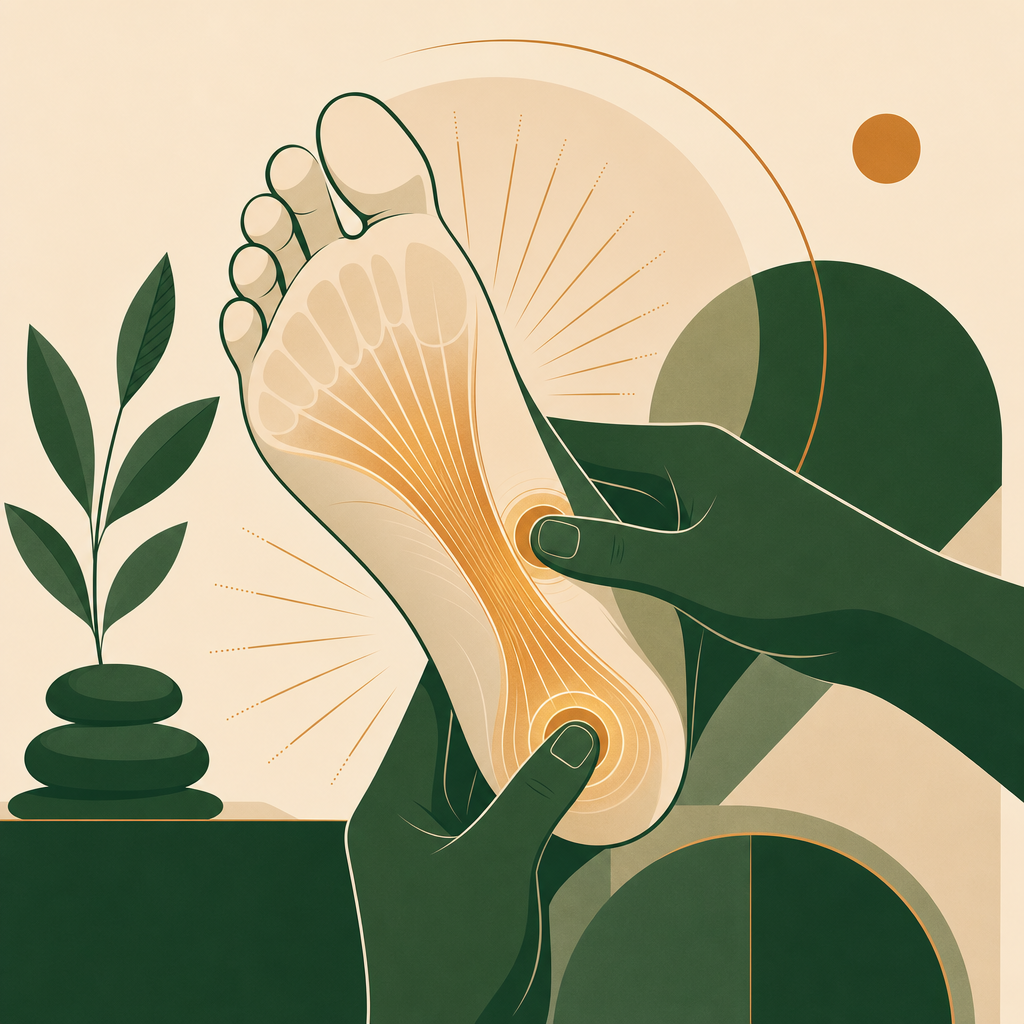
Once the calves are released, I move to the foot itself. I use deep, cross-fiber friction along the entire length of the plantar fascia — from the heel to the ball of the foot. The goal is to break down adhesions between the fascia and the underlying muscles, and to stretch the fascia gently in all directions.
I also use sustained thumb pressure on specific trigger points in the foot. The abductor hallucis (the muscle along the inner edge of the foot) often has tight bands that pull on the arch. The flexor digitorum brevis (under the arch) frequently has knots that refer pain to the heel.
Toe and Arch Mobilization
I mobilize each toe individually. Yes, all ten. When your toes don't move properly, your gait changes, and the plantar fascia compensates. The big toe is especially important — it should be able to extend at least 60 degrees during the push-off phase of walking. Most people with plantar fasciitis have limited big toe extension, and restoring that range makes a significant difference.
I also work on the intrinsic muscles of the foot — the small muscles inside the foot that control fine movements. These muscles atrophy when you wear supportive shoes all the time, and strengthening them is an important part of long-term relief.
Reflexology Connection
This is where it gets interesting. The foot is a map of the body in reflexology, and while I don't claim reflexology can diagnose or cure disease, I've found that stimulating specific reflex points on the foot has a remarkable effect on reducing overall tension. Releasing the reflex points for the spine, hips, and shoulders often helps people relax deeply, which in turn allows their feet to release more fully.
I incorporate gentle reflexology techniques into every foot massage session, even if the primary goal is plantar fasciitis relief. The relaxation response alone is worth it.
What You Can Do at Home
Between massage sessions, here's what I recommend to every plantar fasciitis client:
Roll, Don't Tug
The frozen water bottle roll is popular for a reason — it combines cold therapy with gentle massage. But here's the trick: don't just roll back and forth. Let the foot settle on the bottle for 10-15 seconds at the tightest spots. This allows the fascia to start releasing rather than just being superficially stimulated.
Stretch Your Calves, Not Just Your Foot
Five times more impactful than any foot stretch. Do a wall calf stretch with your knee straight (targets gastrocnemius) and with your knee bent (targets soleus). Hold each for 30 seconds, three times a day. I cannot overstate how much this helps.
Toe Spreading
This sounds silly but it works. Sit down, cross one leg over the other, and use your hand to spread your toes apart gently. You want to create space between each toe. Hold for 10-15 seconds. Repeat several times. This stretches the plantar fascia transversely and helps restore normal foot mechanics.
Footwear Matters
If you have plantar fasciitis, the shoes you wear indoors matter as much as your outside shoes. Walking barefoot on hard floors is one of the worst things you can do — it puts maximum tension on the plantar fascia. Get supportive house slippers or shoes with arch support. Don't walk barefoot until the pain is resolved.
When to Expect Results
Plantar fasciitis is stubborn. It didn't develop overnight, and it won't resolve overnight. But here's a realistic timeline with consistent massage therapy:
After 1-2 sessions: The morning pain should be less intense. You'll still have some stiffness, but that first-step stab should be milder. The tightness in your calves will start to decrease.
After 3-5 sessions: The pain during daily activities should be significantly reduced. You should be able to stand for longer periods without discomfort. Morning stiffness should be brief, not debilitating.
After 6-8 sessions: Most people are pain-free or close to it. Occasional flare-ups might happen after long days or intense activity, but they should be manageable and short-lived.
Maintenance: Monthly foot massages help prevent recurrence. The calves and feet need ongoing care, especially if you're on your feet a lot.
Calf Tightness and Plantar Fasciitis — The Inseparable Link
I want to hammer this home because I see so many people treating the foot while ignoring the calf, and it breaks my heart. Your calf and your plantar fascia are mechanically linked through your heel. Tight calves = constant pull on the heel = tension on the plantar fascia = inflammation and pain.
It's like treating a fraying rope at one end while someone is pulling on the other end with all their strength. You can patch the frayed part all you want, but as long as the tension is there, it will fray again.
That's why a superficial foot massage — the kind where someone rubs your feet with lotion for twenty minutes — doesn't fix plantar fasciitis. It feels nice, but it doesn't address the mechanical drivers. A therapeutic foot massage that includes thorough calf work, specific fascial techniques, and joint mobilization? That changes things.
Priya, the schoolteacher I mentioned? She told me on her last visit that she couldn't believe she'd suffered for a year when the solution was right there. "My calves were the problem all along," she said. "Nobody ever told me to stretch my calves. Every article mentioned the tennis ball and the frozen bottle. Nobody mentioned the calves."
Well, now you know. Your plantar fasciitis might start in your foot, but the solution starts in your calf.
Client Stories: Real Relief at Raipur SPA
Priya isn't the only success story. Take Anil, a software engineer in Raipur who spends ten hours a day at his desk. His plantar fasciitis stemmed from a combination of tight calves from sitting with his feet tucked under the desk and the sudden switch to standing desks at his office. He came to Raipur SPA after three months of hobbling through his morning commute. Like Priya, his calf release was the turning point. After five sessions — two per week for the first two weeks, then weekly — Anil's morning pain was gone and he could stand at his new standing desk without discomfort.
Then there's Meera, a mother of two who developed plantar fasciitis during her second pregnancy. She assumed it was just part of being on her feet all day with a toddler, and that it would 'go away on its own.' Two years post-partum, it hadn't. The combination of pregnancy-related weight changes, weakened foot intrinsics from reduced activity, and the constant demands of childcare had created a perfect storm. At Raipur SPA, we combined foot massage with toe mobilization and a home routine of simple intrinsic foot exercises — towel curls, short foot exercises, and marble pick-ups. Within eight weeks, she was pain-free for the first time in over two years.
These stories share a common thread: the people who recover fastest from plantar fasciitis are the ones who commit to both professional treatment and at-home care. Massage alone works. Massage plus daily stretching and mindful footwear? That's transformative.
How to Know If You Need Professional Help
Not every case of heel pain requires professional intervention. Mild plantar fasciitis — pain that appears only after prolonged activity and resolves quickly with rest — often responds well to home care alone. But here's when you should seek professional massage therapy at Raipur SPA:
- Morning pain lasts more than 15 minutes: If you're limping for more than a few steps every morning, the fascia is significantly irritated.
- Home care hasn't worked after 4 weeks: If ice rolling, calf stretching, and supportive shoes haven't made a dent in a month, you need deeper interventions.
- Pain spreads to your arch or ankle: This suggests the entire fascial network is involved, not just the heel attachment.
- You've changed your gait: If you're walking differently to avoid pain, you risk developing secondary problems in your knees, hips, or lower back.
If any of these describe you, don't wait. The longer you let plantar fasciitis progress, the more chronic the changes become in the fascia. Early intervention — even just a few targeted massage sessions — can shorten your recovery time dramatically.
Heel pain making every step miserable? Book a foot massage session at Raipur SPA, Samta Colony. Real relief starts here. Visit raipurspa.com or call us.
Keywords: plantar fasciitis massage, foot pain relief, heel pain massage, calf release, Raipur SPA
People Also Ask
Related Articles
Deep Tissue & Pain Relief Massage
Hip Pain Relief: The Massage Techniques That Actually Work
14 min read · 12 May 2026
Deep Tissue & Pain Relief Massage
Knee Pain After Running: Massage Therapy for Knee Recovery
13 min read · 12 May 2026
Deep Tissue & Pain Relief Massage
Hand and Wrist Massage for Gamers, Typists, and Artists
13 min read · 12 May 2026
Enjoyed This Article?
Stop reading about relaxation — come experience it firsthand at Raipur SPA.