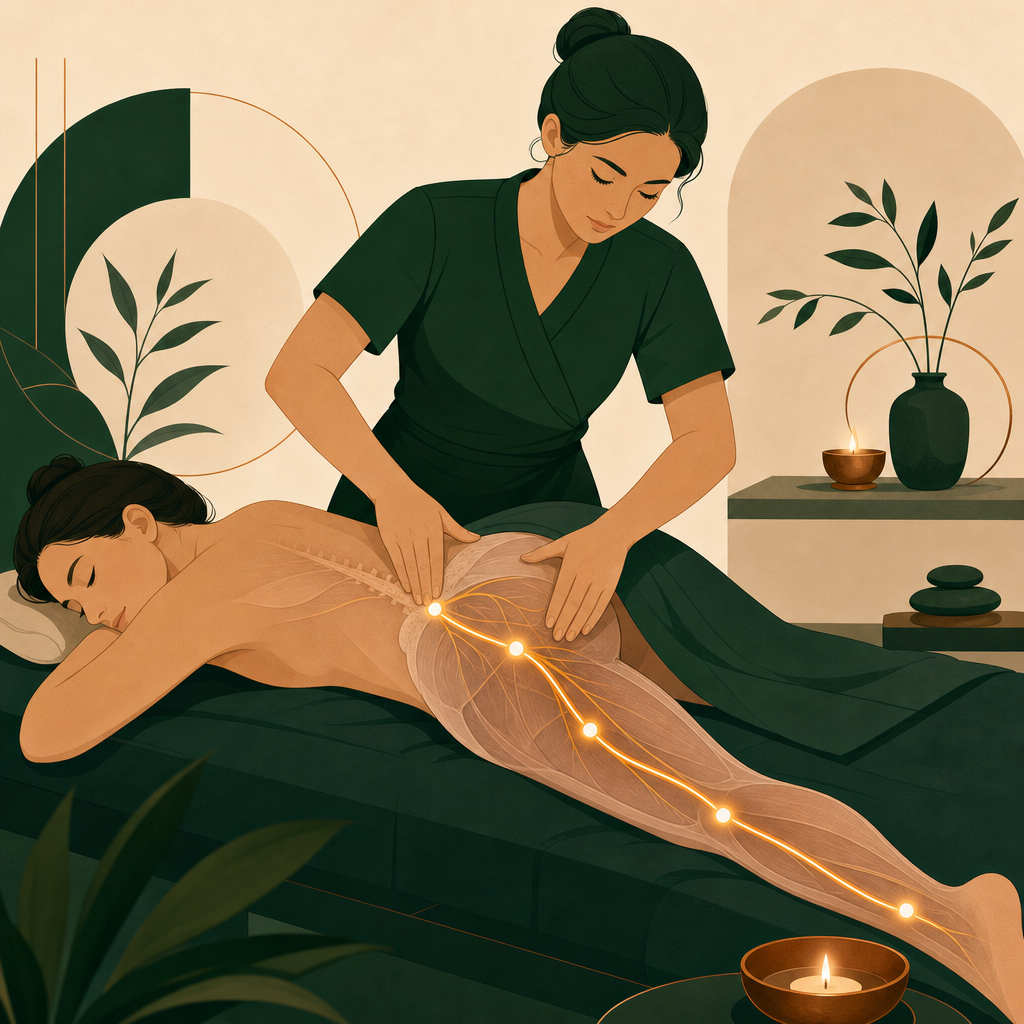
Sciatica Massage: What Works and What Doesn't
I had a client last year who'd been dealing with sciatica for eighteen months. Eighteen months of pain radiating down his left leg. Eighteen months of disrupted sleep, of sitting on the edge of his chair instead of the back of it, of declining invitations because he didn't want to spend the evening shifting uncomfortably.
He'd had an MRI. He'd seen two orthopedists. One told him he had a bulging disc and needed surgery. The other told him the disc was fine and the problem was muscular. He'd tried chiropractic, acupuncture, and enough ibuprofen to stock a pharmacy. Nothing gave him lasting relief.
He walked into Raipur SPA in Samta Colony skeptical. "My wife made me come," he said. "She read about massage for sciatica online."
After his first session, he stood up from the table, took a few steps, and said — I will never forget this — "It's quieter."
The pain wasn't gone, but the shout had turned into a whisper. We worked together for six sessions over two months. By the fourth session, he was sleeping through the night. By the sixth, he was walking his dog twice a day again. Eighteen months of suffering, and he hadn't tried massage until his wife forced the issue.
I'm telling you this story because it illustrates something I see all the time: people with sciatica are desperate for relief, and they've been told that the options are surgery, injections, or a lifetime of "managing it." Massage is rarely presented as a serious option, even though the evidence shows it's remarkably effective for a large percentage of sciatica cases.
Understanding Sciatica — The Critical Distinction
Here's the most important thing to understand about sciatica: it's a symptom, not a diagnosis. "Sciatica" simply means pain that follows the path of the sciatic nerve — from the lower back, through the buttock, and down the leg, sometimes all the way to the foot. What's causing that nerve irritation is the real question, and the answer determines whether massage will help.
There are two broad categories:
Disc-Related Sciatica
This is caused by a herniated or bulging disc in the lumbar spine compressing a nerve root before it even becomes the sciatic nerve. The hallmark: the pain is usually in the lower back as well as the leg, and it's often associated with a specific event — bending over to pick something up, a sudden twist, a car accident.
Can massage help disc-related sciatica? Yes, but with caveats. Massage can't fix a herniated disc directly — that's a structural issue. But it can dramatically reduce the muscle spasms that occur around the injured disc. When the paraspinal muscles, the quadratus lumborum, and the hip muscles go into spasm to protect an injured disc, they create additional compression and irritation. Releasing those muscles reduces the overall load on the spine and allows the disc to heal more effectively.
Piriformis Syndrome
This is where massage truly shines. The piriformis muscle runs from your sacrum to your femur, and the sciatic nerve runs directly under it (or through it, in about 15% of the population). When the piriformis gets tight, inflamed, or spasming, it compresses the sciatic nerve, causing pain that mimics disc-related sciatica almost perfectly.
The classic signs of piriformis-related sciatica: the pain is primarily in the buttock and down the back of the thigh, it gets worse with prolonged sitting, and the lower back itself feels relatively pain-free. There's often a specific tender point in the buttock that, when pressed, reproduces the leg symptoms.
In my experience, a very large percentage of sciatica cases labeled "idiopathic" (meaning the doctors couldn't find a clear cause) are actually piriformis syndrome that was missed because nobody thought to check. And the treatment for piriformis syndrome is straightforward: release the piriformis muscle.
What Works for Sciatica Massage
Based on what I've seen work consistently at Raipur SPA, here's the approach that delivers results:
Piriformis Release
This is the money technique for piriformis-related sciatica. The client lies face down. I locate the piriformis — it runs roughly from the sacrum to the top of the femur, deep under the glute max. I use sustained pressure with my elbow or knuckles, working slowly and methodically. The key is patience. The piriformis is a deep muscle, and it takes time for the pressure to penetrate. I'm not trying to "break up" the muscle. I'm applying consistent, tolerable pressure and waiting for the muscle to let go.
I also use active release techniques — having the client move their leg through specific ranges while I maintain pressure on the muscle. This helps restore normal gliding between the piriformis and the sciatic nerve.
Gluteal and Hip Work
The glutes are almost always involved. When the piriformis is tight, the glutes compensate, and vice versa. I release the glute max, glute med, and glute min using a combination of broad compression, trigger point work, and stretching.
The deep six lateral rotators — the piriformis plus five other small muscles that rotate the hip — get individual attention. These muscles are often overlooked, but they can all contribute to sciatic nerve compression.
Lower Back and Paraspinal Release
Even if the lower back itself isn't painful, the paraspinal muscles are almost always tight in response to any sciatica. I release the lumbar paraspinals, the quadratus lumborum (a deep muscle connecting the hip to the lower ribs), and the thoracolumbar fascia. This creates space in the lower back and reduces the overall tension pattern that's contributing to the nerve irritation.
Nerve Flossing
This is a critical component that many massage therapists skip. The sciatic nerve needs to be able to glide freely through its surrounding tissues. When it's stuck at any point — in the lower back, in the buttock, in the hamstring, in the calf — every movement creates tension and irritation. I use controlled nerve flossing techniques to mobilize the nerve, always staying within a pain-free range.
What Doesn't Work
Let me be honest about what doesn't work, because there's a lot of bad advice out there:
- Deep digging right on the point of pain. If the sciatic nerve is already irritated, direct pressure on the nerve itself will make things worse. You need to release the structures around the nerve, not attack the nerve.
- Stretching the hamstrings aggressively. When the sciatic nerve is irritated, tight hamstrings are often a protective response. Aggressive stretching can actually pull on the nerve and worsen symptoms. Gentle, pain-free stretches only.
- Foam rolling the sciatic nerve directly. Please don't do this. I've had clients come in who've made themselves significantly worse by aggressively foam rolling their buttocks and hamstrings. You can irritate the nerve further.
- Heat on an acute flare-up. Heat increases blood flow, which sounds good. But in an acute flare-up where the nerve is inflamed, heat can increase inflammation. Ice for acute flare-ups. Heat for chronic, tight-but-not-flaring muscles.
What to Expect from Sciatica Massage
Sciatica is rarely a one-session fix. Here's a realistic timeline:
Session 1: You should feel noticeable relief immediately after the session. The "shout" becomes a "whisper." But the relief may only last a few hours to a couple of days initially. Don't be discouraged — this is normal. Your body has been in a protective pattern for a long time, and it needs repeated input to learn that it can let go.
Sessions 2-4: The relief lasts longer — a day, then two days, then three. The quality of sleep improves. You start noticing when you're sitting in a way that aggravates the nerve. You become more aware of your body.
Sessions 5-8: Most people with piriformis-related sciatica are significantly better by this point. Disc-related sciatica may take longer, but the trajectory should be consistently improving.
Maintenance: Once the pain is under control, monthly or bi-monthly sessions help prevent recurrence.
Posture Correction: The Foundation of Sciatica Prevention
If you're dealing with sciatica, your posture is almost certainly playing a role. Let me walk you through the specific postural issues I see most often and how to fix them:
Forward Head Posture and Sciatica
It sounds strange — how does your head position affect your sciatic nerve? — but the connection is real and direct. When your head is forward of your shoulders (which happens when you look at a phone or computer screen), your upper back rounds and your lower back arches to compensate. This increases the curve in your lower back (lumbar lordosis), which narrows the space where the nerve roots exit your spine. Over time, this puts chronic pressure on the nerve roots and makes you more susceptible to sciatica.
The fix: be aware of your head position. Your ears should be in line with your shoulders when viewed from the side. When you catch your head drifting forward — and you will, constantly — gently tuck your chin and bring your head back over your shoulders. I call this the "chin tuck," and it's the single most effective postural correction you can make for both your back and your sciatic nerve. Do it 10-15 times throughout the day, and you'll train your body to hold a more neutral head position.
Sitting Posture: The Deep Chair Problem
Deep, cushy chairs feel comfortable, but they're terrible for your back and sciatic nerve. When you sink into a deep chair, your hips drop below your knees and your lower back rounds. This puts the sciatic nerve on a stretch and compresses the lumbar discs. The fix: sit on the front edge of your chair, with your hips higher than your knees. Your feet should be flat on the floor. A wedge cushion that tilts your pelvis slightly forward can make a huge difference — it maintains the natural curve of your lower back and takes pressure off the nerve.
The Half-Stand for Prolonged Sitting
If you have a desk job, I recommend a standing desk that can alternate between sitting and standing. But if that's not available, here's a simple trick: every 20-30 minutes, stand up for 30 seconds. Just stand. This takes the pressure off the sciatic nerve, changes the load on your discs, and resets your postural muscles. It sounds too simple to work, but I've had clients whose sciatica improved dramatically just from incorporating frequent standing breaks into their workday.
Strengthening Exercises for Long-Term Sciatica Prevention
Once the acute pain is under control, building strength in the right areas is the best thing you can do to prevent sciatica from returning. Here are the exercises I recommend most:
Glute Bridges
Your glutes are your body's most powerful shock absorbers. When they're weak, your lower back and piriformis take on extra work. Lie on your back with your knees bent and feet flat. Squeeze your glutes and lift your hips toward the ceiling. Hold at the top for two seconds, then lower slowly. The key: actually squeeze your glutes. Most people just lift with their lower back. Do three sets of 15 repetitions. Once that's easy, progress to single-leg glute bridges.
Bird Dogs for Core and Back Stability
This exercise builds core stability without loading your spine. Start on your hands and knees. Keeping your back flat, extend your right arm forward and your left leg backward simultaneously. Hold for three seconds, then return to start. Alternate sides. Do 10 repetitions per side. The key: don't let your lower back sag or arch. If your back starts to move, reduce your range of motion. This is about control, not distance.
Hip Hinges for Hamstring and Glute Health
The hip hinge is one of the most important movement patterns for sciatica prevention, but almost nobody does it correctly. Stand with your feet hip-width apart. Keep your back flat — imagine a broomstick running from the back of your head to your tailbone. Push your hips backward as if you're closing a car door with your butt. You should feel the stretch in your hamstrings, not your lower back. Return to standing by squeezing your glutes. This movement trains your body to bend correctly, taking pressure off your lower back and sciatic nerve. Start with body weight only, and once you're comfortable, you can add light dumbbells.
Sleeping Positions for Sciatica Relief
How you sleep can either help or hurt your sciatica recovery. Here's what I recommend:
For Piriformis-Related Sciatica
Sleep on your non-painful side with a pillow between your knees. This keeps your top hip from dropping forward, which can compress the piriformis. The pillow doesn't have to be expensive — any firm pillow or cushion that keeps your knees hip-width apart will work. If you have pain on both sides, try sleeping on your back with pillows under your knees.
For Disc-Related Sciatica
Sleeping on your back with a pillow under your knees is your best option. This maintains the natural curve of your lower back and takes pressure off the lumbar discs. If you need to sleep on your side, curl in the fetal position with a pillow between your legs. Avoid sleeping on your stomach — it hyperextends your lower back and can worsen disc-related symptoms.
More Real Client Stories
Sunita — The Teacher Who Couldn't Stand
Sunita taught at a school in Raipur and was on her feet most of the day. Her sciatica started as a mild ache in her right buttock, but within a few months she couldn't stand for more than 10 minutes without pain shooting down her leg. She'd been told she had a bulging disc at L4-L5 and was scheduled for an epidural steroid injection. Before going through with it, she decided to try massage as a last resort. When I examined her, I found her piriformis was rock-hard on the right side, and her quadratus lumborum on the same side was in spasm. Her glute med was so weak she wobbled when standing on her right leg. Over eight sessions, we released the piriformis, strengthened the glutes, and corrected the muscle imbalance that was pulling her pelvis into a rotated position. She canceled her injection appointment after session five. Six months later, she was still symptom-free.
Rajesh — The Gym-Goer Who Overdid It
Rajesh was an avid gym-goer in his late forties who developed sciatica after increasing his deadlift weight too quickly. His initial diagnosis was "lumbar strain with nerve root irritation," and he was told to rest for six weeks. He came to me after three weeks because rest alone wasn't helping. His lower back muscles were in protective spasm, and his hamstrings — which he'd been stretching aggressively trying to relieve the pain — were actually making things worse. We focused on gentle paraspinal release, nerve flossing, and passive hamstring work. I also gave him specific instructions on walking form — taking shorter steps and engaging his glutes with each stride to reduce the load on his lower back. Within four sessions, the radiating pain was gone. He returned to lifting gradually, using proper bracing techniques, and now deadlifts heavier than before without any back or leg symptoms.
When to See a Doctor Before Massage
Massage is powerful, but there are red flags that require medical attention:
- Loss of bladder or bowel control — this is a medical emergency (cauda equina syndrome)
- Numbness in the "saddle area" — genitals and inner thighs
- Progressive weakness in your leg or foot — especially foot drop (can't lift your toes)
- Severe pain that comes on after a traumatic injury
- Unexplained weight loss accompanied by back pain
If you have any of these symptoms, go to an emergency room or see a doctor immediately.
But if your sciatica is the kind that comes and goes, that's been diagnosed as "muscular" or "idiopathic," or that your doctors have told you to "learn to live with" — massage is not just worth trying. It might be exactly what you've been missing.
That client who'd been suffering for eighteen months? He told me something on his last visit that I still think about. He said, "I spent a year and a half trying everything except the one thing that worked. Nobody ever suggested massage. Not one doctor. Not one surgeon. Nobody."
That's why I'm writing this. Because I want everyone in Raipur with sciatica to know that this option exists, it works, and it's available right here at Raipur SPA in Samta Colony.
Sciatica pain disrupting your life? Get evidence-based massage therapy at Raipur SPA, Samta Colony. Book online at raipurspa.com.
Keywords: sciatica massage, nerve pain relief, lower back massage, piriformis release, Raipur SPA
People Also Ask
Related Articles
Deep Tissue & Pain Relief Massage
Hip Pain Relief: The Massage Techniques That Actually Work
14 min read · 12 May 2026
Deep Tissue & Pain Relief Massage
Knee Pain After Running: Massage Therapy for Knee Recovery
13 min read · 12 May 2026

Deep Tissue & Pain Relief Massage
Hand and Wrist Massage for Gamers, Typists, and Artists
13 min read · 12 May 2026
Enjoyed This Article?
Stop reading about relaxation — come experience it firsthand at Raipur SPA.