Cricket Injury Prevention: Massage for Bowlers and Batsmen
Introduction: The Uniqueness of Cricket Injuries
If you've never played cricket, it might look like a gentle game — a few blokes in white, waiting around for something to happen, then a bit of running, then more waiting. But anyone who has actually played — especially at any level of seriousness — knows that cricket puts your body through a very particular kind of stress that has almost no parallel in any other sport.
I've been working with cricketers from Raipur and across Chhattisgarh for years now, and every time a new player walks into my therapy room at Raipur Spa in Samta Colony, I'm reminded just how different the game's demands are. A fast bowler runs in, contorts their body in ways that should be illegal, and delivers a ball at speeds that can exceed 140 kilometres per hour — then does it again, and again, and again, sometimes for hours at a stretch. A batsman stands in a crouched position, then explodes into a shot that uses every joint from their wrists to their spine, all while managing the impact of a hard leather ball travelling at speed.
It's not a gentle sport. And it produces a very specific set of problems.
In this article, I'm going to break down the most common cricket injuries I see — by position — and explain how targeted massage therapy can help prevent them. Whether you're a pace bowler with a nagging back, a spinner with a shoulder that isn't quite right, or a batsman dealing with wrist pain, there's something here for you.
The Fast Bowler's Body: A Case Study in Asymmetry
Let's start with fast bowlers, because they bear the highest injury burden in the game. Studies have shown that fast bowlers account for roughly 40-50% of all cricket injuries, and the numbers are even higher at the amateur level where conditioning and recovery are less structured.
The fast bowling action is biomechanically violent. As the bowler runs in, plants the front foot, and rotates the torso, immense forces are transmitted through the spine — particularly the lumbar region. The quadriceps and glutes of the landing leg absorb forces several times body weight. The shoulder of the bowling arm is whipped through an extreme range of motion. And all of this is repeated hundreds of times in a single match.
The result? A body that is dramatically asymmetrical. The bowling side develops overdeveloped muscles. The non-bowling side becomes comparatively weaker. And that imbalance is where injuries incubate.
Shoulder Issues in Fast Bowlers
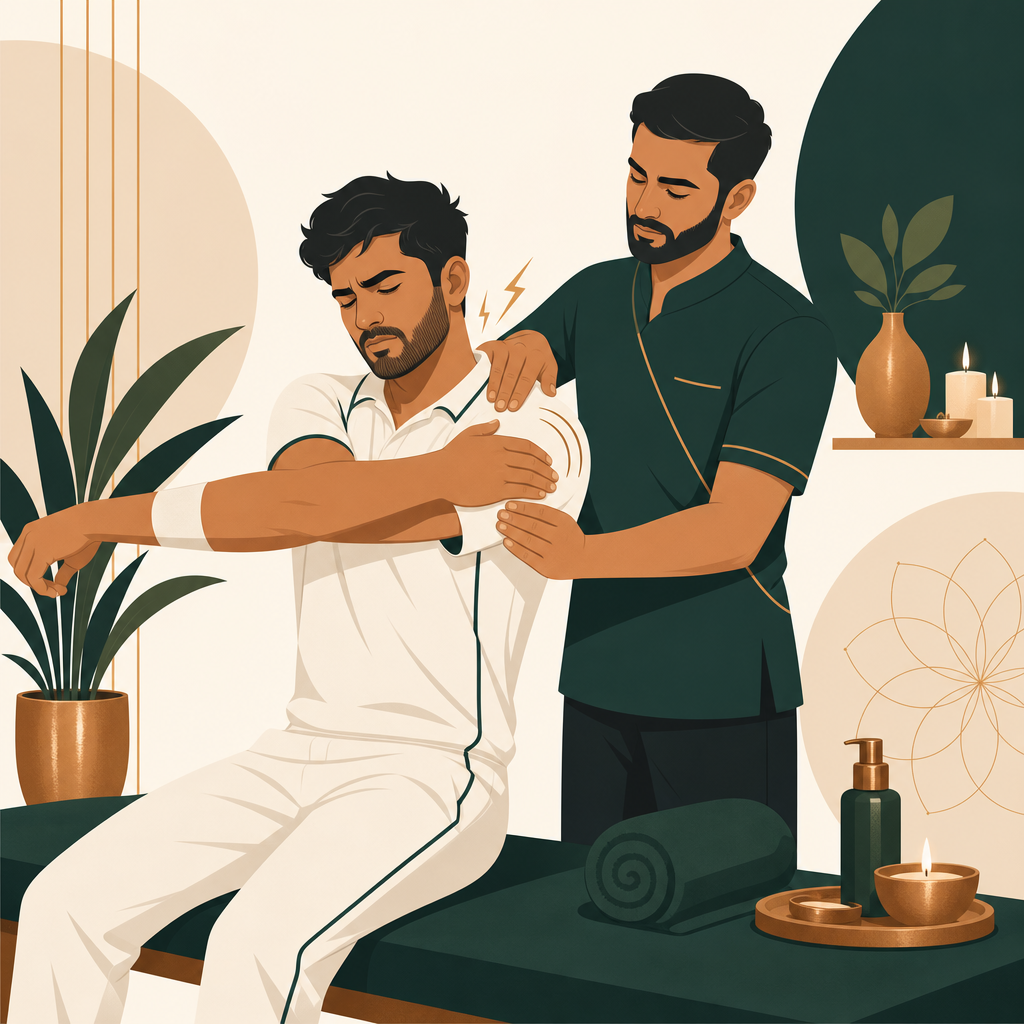
I worked with a young pace bowler from Raipur — let's call him Vikram — who was barely 19 years old and already bowling at a decent clip. He came to me complaining of persistent shoulder pain that had been bothering him for about three months. He had tried rest. He had tried ice. He had tried "just bowling through it." Nothing worked.
When I assessed him, I found that his anterior deltoid and pectoralis major on the bowling side were significantly tighter than the posterior cuff — the rotator cuff muscles at the back of the shoulder. This is a classic fast bowler pattern. The deceleration phase of the bowling action — the part where you stop your arm after releasing the ball — puts enormous eccentric load on the posterior rotator cuff. If those muscles are already weak or inhibited, the shoulder becomes unstable. And an unstable shoulder is an injured shoulder.
For Vikram, I used a combination of techniques. First, I released the tight anterior structures — the pecs and anterior deltoid — using sustained pressure and myofascial release. This immediately improved his shoulder mobility. Then I worked on the rotator cuff muscles — the infraspinatus and teres minor — using deeper, more specific trigger point therapy. Finally, I gave him a home care protocol with stretches and — crucially — strengthening exercises for the neglected posterior cuff.
Three sessions over two weeks, plus the strengthening work, and his pain was gone. He's still bowling fast today, and he comes in monthly for maintenance work.
The lesson is simple: bowlers need to treat their shoulders like the high-performance machine parts they are. The bowling shoulder takes a pounding that is almost unique in sports. It needs regular maintenance — not just when it hurts.
The Bowler's Back: Lumbar Lordosis and Disc Stress
If I had a rupee for every fast bowler who has walked into my room complaining of lower back pain, I'd be a wealthy man. The statistics back this up — lower back injuries account for up to 30% of all time lost in cricket, and fast bowlers are disproportionately affected.
The mechanism is well understood by now. During the delivery stride, as the front foot lands and the torso rotates, the lumbar spine goes into hyperextension and rotation simultaneously. This combination — extension plus rotation — is the worst possible position for the lumbar discs. Repeated hundreds of times, it can lead to stress fractures (spondylolysis), disc bulges, and chronic facet joint irritation.
I had a 28-year-old club cricketer from Samta Colony who came to me after being told he had a "minor disc bulge" by a doctor in Raipur. The doctor had prescribed rest and painkillers. After three months of doing nothing, he was still in pain. Why? Because the issue wasn't just the disc. The issue was that his erector spinae muscles on one side had gone into chronic spasm as a protective response, and that spasm was pulling his spine out of alignment and perpetuating the problem.
I worked on releasing those tight paraspinal muscles — slowly, patiently, because a back that has been guarding for months doesn't let go easily. I also worked on his quadratus lumborum, which was tight on the bowling side, and his gluteals, which were also in spasm. We did some gentle mobilisation of the lumbar spine. And within four sessions, his pain was manageable. Within eight, it was gone.
For bowlers who want to prevent back issues, here's what I recommend: get regular massage focusing on the erector spinae, quadratus lumborum, and gluteals. These are the muscles that absorb the rotational forces of bowling. Keep them supple. And please — strengthen your core. Your abs and obliques are your spine's best friends. A strong core reduces the load on your lower back by providing a stable platform for the pelvis and spine.
The Spinner's Unique Challenges
Spinners might not bowl at the same speed as pacers, but they have their own set of problems. The finger spinner — off-spinner or leg-spinner — puts enormous stress on the fingers, wrist, and forearm. The shoulder still gets significant work, especially from the loading phase of the action. And the knees — particularly the landing knee — can develop problems over the long term.
For finger spinners, the index and middle fingers bear the brunt of the work. The amount of spin a good spinner imparts requires significant finger strength and flexibility. Over time, the tendons in those fingers can develop strains, and the interphalangeal joints can become arthritic — I've seen this happen in bowlers who have been spinning for twenty years or more.
Regular massage of the forearm flexors and extensors can help prevent these problems. The muscles that control finger movement originate in the forearm, and keeping them supple reduces the strain on the finger tendons. I also recommend gentle stretching of the fingers — the kind of thing that feels weird until you make it a habit.
For wrist spinners — the rare breed who bowl wrist-spin — the wrist takes the biggest hit. The wrist needs to be flexible enough to impart spin but stable enough to control the ball. Gymnast wrist stretches and gentle manipulation of the carpal bones can help maintain range of motion. Massage of the wrist extensors and flexors — combined with specific release of the muscles of the thenar eminence (the thumb pad) — can prevent the chronic wrist pain that often ends spinner's careers prematurely.
The Batsman's Wrists and Hands
Batsmen don't get enough attention when it comes to injury prevention. The popular perception is that batting is the "safer" part of the game. But anyone who has held a bat for three hours in a limited-overs match knows that's nonsense.
Batting requires a death grip on the bat handle, especially when playing against pace bowling. That grip is maintained through the forearm flexors, which stay contracted for the entire innings. Over a long innings — or a series of innings — those forearms get tight, and that tightness can refer pain into the elbow and wrist.
One of my regulars, a top-order batsman for a local club in Raipur, came to me with what he thought was "tennis elbow." He had pain on the outside of his elbow that was affecting his shots. He had tried anti-inflammatories and a brace, but nothing helped. When I examined him, I found that it wasn't actually tennis elbow — the problem was in his forearm extensors, which were chronically tight from gripping the bat. The tightness was referring pain up into the elbow.
I worked on deep tissue release of the extensor muscles — particularly the extensor carpi radialis brevis — combined with stripping techniques along the full length of the forearm. I also addressed his wrist flexors, because when one side of the forearm gets tight, the other side compensates and also becomes restricted. After two sessions, his elbow pain was significantly reduced. After four, it was gone — without any change to his batting technique or equipment.
For batsmen, I recommend regular forearm massage — particularly during tournament periods when you're playing or training daily. The forearms are the most overlooked muscle group in cricket. Keep them loose, and you'll reduce your risk of elbow, wrist, and hand problems significantly.
Thigh and Hamstring Injuries in Cricket
Running between wickets might look straightforward, but it's actually one of the most explosive movements in the game. A batsman might be static one moment and sprinting the next, often from a crouched or unbalanced position. And that start-stop nature of running between wickets is a recipe for hamstring strains.
I've seen countless cricketers — both batsmen and fielders — with hamstring pulls. The classic case is someone who is mid-30s, plays a tournament over two weekends, doesn't warm up properly, and then tears their hamstring chasing a ball in the deep or pushing for a second run.
Prevention is straightforward: keep your hamstrings flexible through regular massage and stretching. I use a combination of myofascial release on the hamstring group, combined with gentle stretching to improve flexibility. The key is to address the hamstrings when they're NOT injured — maintenance massage during training periods can reduce your injury risk dramatically.
The same goes for quadriceps and adductors (groin). Fast bowlers, in particular, are prone to groin strains because of the wide delivery stride. I've found that regular massage of the adductor group, combined with hip mobility work, significantly reduces groin strain incidence in bowlers.
Fielding: The Overlooked Injury Generator
Everyone focuses on bowling and batting, but fielding produces its own share of injuries. Diving stops can injure shoulders (already a problem for bowlers). Sliding can cause hip and thigh contusions. Diving catches can jam fingers. And outfield throwing — especially from the deep — puts enormous stress on the shoulder and elbow.
I had a fielder who came to me with shoulder pain that he thought was from bowling. Except he was a wicketkeeper. His shoulder pain was actually from repetitive throwing — the kind of long, flat throws that fielders make from the boundary. The posterior capsule of his shoulder was tight, and his external rotators were weak.
Massage of the posterior shoulder, combined with rotator cuff strengthening, fixed him in three sessions. And now he knows — it's not just bowlers who need shoulder maintenance.
A Cricket-Specific Maintenance Schedule
If you're a serious cricketer — or even a weekend warrior who wants to stay injury-free — here's a schedule I recommend based on what works for my clients:
During Tournament Season:
- One sports massage session per week, focusing on position-specific areas (shoulder/back for bowlers, forearms/hips for batsmen, full body for wicketkeepers and all-rounders)
- Daily self-massage of forearms and calves using a ball or roller
- Stretching after every match and training session
Off-Season:
- One massage session every two to three weeks
- Focus on correcting imbalances that developed during the season
- Deep tissue work to break up adhesions and scar tissue
Before a Big Match:
- A light massage 24-48 hours before the game — not deep, just mobilising and relaxing
- Avoid deep work within 24 hours of bowling or batting
- Arrive at the ground early enough for a proper warm-up
After a Big Match:
- Light stretching immediately after play
- Book a recovery massage within 48 hours
- Hydrate like it's your job
The Core Message: Don't Wait Until You're Injured
The most frustrating clients I see are the ones who come to me only when they're in significant pain. "I should have come earlier," they always say. And they're right.
Massage therapy for cricketers shouldn't be reactive. It shouldn't be something you do when your shoulder is already hurting or your back has already locked up. It should be a regular part of your training routine — a proactive investment in your body's longevity in the sport.
Think about it this way. You oil your bat. You maintain your kit. You practice your skills relentlessly. Why wouldn't you give the same attention to the most important piece of equipment you have — your body?
I'm at Raipur Spa in Samta Colony, and I've worked with cricketers of all levels — from young fast bowlers just starting their journey to senior players who have been playing for decades. I understand the specific demands of the sport, and I've built my practice around addressing them.
Your body is your most important cricket gear. Take care of it. Regular massage isn't a luxury. It's part of your training.
People Also Ask
Related Articles

Sports, Fitness & Weight Management
Post-Marathon Recovery: A Runner's Guide to Massage Therapy
15 min read · 12 May 2026
Sports, Fitness & Weight Management
Gym Recovery 101: Pre-Workout vs Post-Workout Massage Timing
11 min read · 12 May 2026

Sports, Fitness & Weight Management
Yoga and Massage: The Perfect Wellness Combo for Flexibility
12 min read · 12 May 2026
Enjoyed This Article?
Stop reading about relaxation — come experience it firsthand at Raipur SPA.