Post-Marathon Recovery: A Runner's Guide to Massage Therapy
Introduction: The Wall, The Finish, and What Comes After
I still remember the look on Ajay's face when he limped into my therapy room at Raipur Spa. He had just finished his first full marathon — 42.2 kilometres through the streets of Bengaluru — and he was walking like a man who had been hit by a truck. His quads were screaming. His calves were knotted into what felt like stone. His hip flexors had essentially gone on strike. And somewhere around kilometre 35, his IT band had decided to make its displeasure very, very clear.
"I thought the hard part was the race," he said, wincing as he lowered himself onto the treatment table. "Nobody told me the recovery would be worse than the running."
He wasn't wrong. The truth is, most runners spend months obsessing over their training plan — the long runs, the tempo sessions, the carb-loading, the gear selection — but they spend almost zero time thinking about what happens after they cross that finish line. And that's a mistake that costs them days, sometimes weeks, of unnecessary pain and delayed healing.
Over my years working with runners in Raipur and beyond, I've seen the same pattern play out again and again. Someone runs a marathon, feels like a superhero for about twelve hours, and then wakes up the next morning unable to walk down a flight of stairs. They reach for ice packs, painkillers, and Google — and that's where things start going wrong.
This guide is my attempt to fix that. Everything I've learned about post-marathon recovery — the science, the timing, the techniques, and the mistakes to avoid — all in one place. Whether you're a first-time marathoner or a seasoned ultrarunner, the principles are the same. Your body has just done something extraordinary. Here's how to help it recover properly.
The First 48 Hours: What's Actually Happening Inside Your Body
Before we talk about massage, I need you to understand what your muscles look like after 42.2 kilometres of continuous pounding. It's not pretty.
During a marathon, your muscle fibres experience micro-tears on a massive scale. We're not talking about the kind of micro-tears that happen during a normal gym session — those are tiny, manageable, and actually beneficial for growth. Marathon-level micro-tears are more like a demolition crew has gone through your legs with a sledgehammer.
On top of that, you've got inflammation. The body's natural response to this kind of trauma is to send all kinds of healing chemicals — cytokines, macrophages, prostaglandins — to the damaged areas. This is good. It means your body is working. But it's also what causes that deep, achey soreness that makes you question your life choices.
Then there's the fluid retention. Your lymphatic system — which is responsible for clearing out metabolic waste from your tissues — gets completely overwhelmed. All those broken-down muscle cells, all that lactic acid (well, mostly cleared by now, but the associated damage remains), all the inflammatory byproducts — they're just sitting there in your interstitial fluid, waiting to be drained away.
And finally, there's the muscle spasm. Your muscles, especially the calves and hamstrings, have been contracting for hours. They're exhausted. They don't know how to fully relax anymore. So they stay in a state of low-grade spasm, which restricts blood flow and makes everything worse.
This is the environment you're dealing with. This is why "just rest and ice" is not enough.
When Should You Get Your First Post-Marathon Massage?
This is the question I get asked more than any other, and the answer depends entirely on who you ask — and what kind of marathon you just ran.
Let me give you the truth, not the conventional wisdom: Do not get a deep tissue massage within 24 hours of finishing a marathon.
I know, I know. Every running magazine tells you to book that post-race massage ASAP. But here's the problem: in the first 24 hours, your muscles are in a state of acute inflammation. They're swollen, angry, and extremely sensitive. A deep tissue massage at this stage — and I've seen this happen — can actually increase inflammation and delay recovery. I had a client from Samta Colony who booked a "sports massage" three hours after finishing the Delhi Half Marathon and wound up unable to walk properly for a week. The therapist went too deep, too soon, and essentially re-injured already damaged tissue.
So what should you do instead?
In the first 24 hours, the focus should be on gentle movement, hydration, nutrition, and — if you're going to do anything hands-on — very light, superficial lymphatic drainage work. And I mean very light. We're talking about the kind of pressure that barely moves the skin. This is not about "working out knots." This is about helping your lymphatic system do its job of clearing waste.
The sweet spot for a proper sports massage is 48 to 72 hours post-race. By this time, the acute inflammatory phase has passed. Your body has started the repair process. The micro-tears are beginning to heal. And your muscles are ready for the kind of work that actually makes a difference.
I tell my clients to aim for day three. Come in on that Tuesday after a Sunday marathon. Your body will thank you.
Runner-Specific Techniques That Actually Work
Not all massages are created equal, especially when it comes to post-marathon recovery. I've developed a specific protocol over the years that addresses the unique problems runners face. Let me walk you through it.
1. The Calf Release
The calves take an absolute beating during a marathon. Every single foot strike — and there are roughly 45,000 of them in a full marathon — sends a shockwave through your gastrocnemius and soleus muscles. By the end of the race, they're shortened, tight, and filled with trigger points.
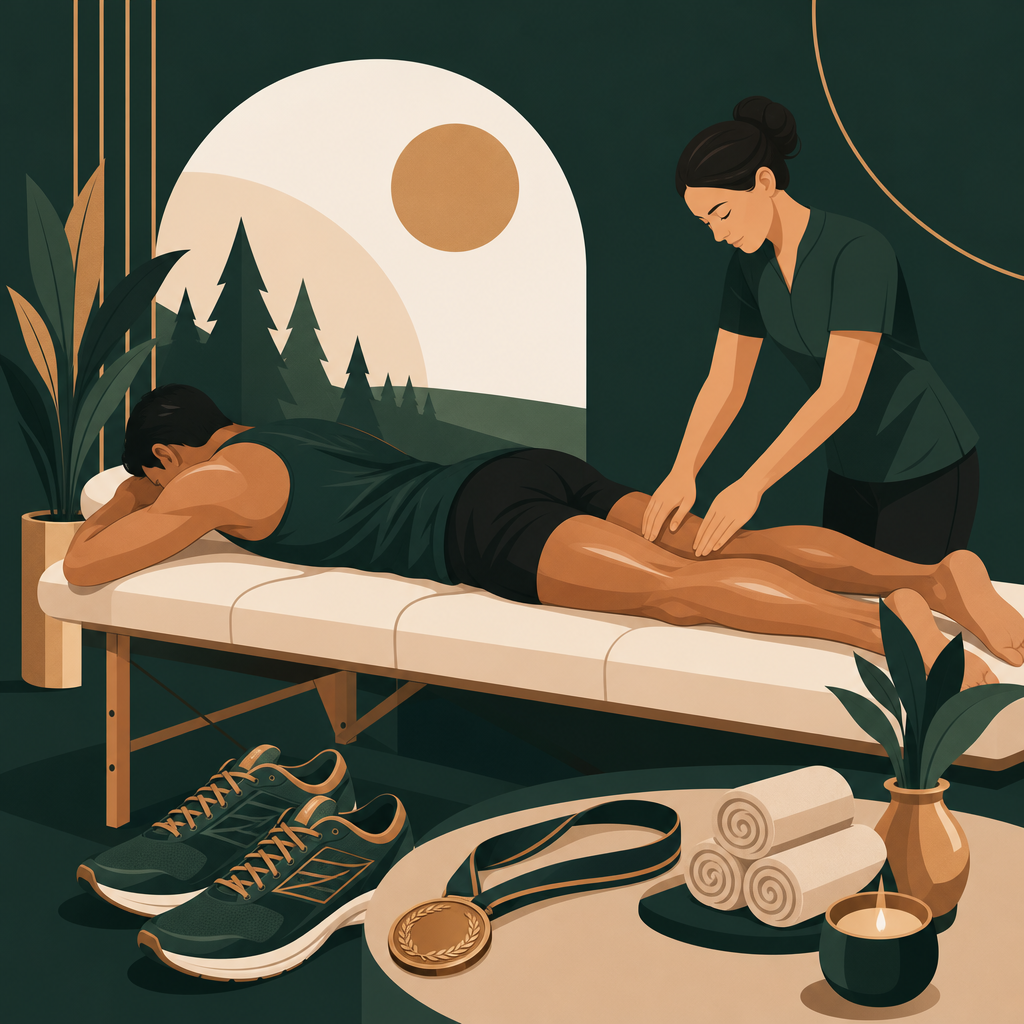
I start with slow, broad compression on the belly of the muscle. No deep elbow work yet. Just using my palm to apply gentle, sustained pressure. Then I move to myofascial release techniques — holding sustained stretches for 90 seconds to two minutes, allowing the fascia to actually lengthen instead of just bouncing off a quick stretch.
The difference between doing this and not doing this? I've seen runners who could barely walk into my room leave an hour later walking almost normally. It's not magic — it's just giving the tissue what it actually needs.
2. The Quad and Hip Flexor Unloading
Runners tend to have tight quads. Marathoners have marble-quads. The rectus femoris — the quad muscle that also crosses the hip joint — gets particularly angry because it's being asked to both extend the knee AND flex the hip, thousands of times, for hours on end.
For this, I use a combination of muscle-stripping techniques along the length of the quadriceps group, followed by specific trigger point work on the rectus femoris and vastus medialis. The key is to work longitudinally — along the direction of the muscle fibres — rather than just jabbing into knots.
The hip flexors need special attention because marathon posture tends to be a slight forward lean with a posterior pelvic tilt. The psoas and iliacus shorten. They get cranky. And a tight psoas can refer pain all the way up into your lower back. I use gentle, patient release work here — nothing aggressive. The psoas is a deep muscle and it doesn't respond well to brute force.
3. The IT Band — Handle With Care
The iliotibial band is not a muscle. It's a thick band of fascia that runs from your hip to your knee. And it does NOT need to be "broken up" with aggressive foam rolling or deep pressure. I cannot stress this enough. Please stop foam rolling your IT band like it owes you money.
What the IT band actually needs is release of the muscles that attach to it — specifically the tensor fasciae latae (TFL) and gluteus maximus. When these muscles are tight, they pull on the IT band, causing that familiar outer knee pain that plagues so many runners.
I work on the glutes and TFL with sustained pressure and gentle stretching, and I address any tightness in the vastus lateralis (the outer quad muscle). Fix those, and the IT band usually calms down on its own.
4. Deep Gluteal Work
Your glutes are your engine. They're supposed to be doing most of the work during running. But after hours of pounding, they get fatigued and develop deep trigger points, especially in the gluteus medius and piriformis.
The piriformis is a particular troublemaker. It sits right on top of the sciatic nerve, and when it tightens up — which it always does post-marathon — it can compress that nerve and cause pain, numbness, or tingling all the way down the leg. I've had runners come in thinking they had a back problem when it was actually just a piriformis that needed five minutes of focused release work.
This is where deep, specific pressure matters. Using elbows and knuckles (with proper draping, of course), I target the trigger points in the gluteal group. It's uncomfortable. Runners usually tell me it's a "good pain." And when I'm done, the difference in their walking mechanics is visible immediately.
The Lymphatic Drainage Component
One thing I don't think enough post-marathon massage protocols address is lymphatic drainage. And I think that's a shame, because it's arguably one of the most beneficial things you can do.
Your lymphatic system doesn't have a pump like your heart does. It relies entirely on muscle contractions, breathing, and manual stimulation to move lymph fluid through your body. After a marathon, your lymphatic system is backed up — like a drain clogged with too much debris.
Manual lymphatic drainage (MLD) uses very light, rhythmic, pumping movements to encourage lymph flow. It's not something you'd typically get in a standard sports massage. But I've incorporated elements of it into my post-marathon protocol because the results are undeniable.
One runner from Raipur — a 45-year-old man who had been running for years — came to me with legs so swollen he couldn't see his ankle bones. He had been icing and elevating for two days with no improvement. After a 30-minute session focused on lymphatic drainage followed by 30 minutes of targeted muscle work, his swelling had reduced by at least 60%. He could see his ankles again. He walked out feeling lighter.
The magic is in the technique. The pressure is so light you barely feel it — just enough to stretch the skin. The movement is slow and rhythmic, following the direction of lymph flow. It's deeply relaxing and profoundly effective.
The Stretching Timing Debate
Should you stretch after a post-marathon massage? The answer is: it depends on timing.
Immediately after the massage, I generally advise against any aggressive stretching. Your muscles have just been worked on. They're relaxed, yes, but they're also vulnerable. Aggressive stretching at this point — especially if the therapist has been doing deep work — can cause micro-tearing of the newly relaxed tissue.
Instead, I recommend waiting 4-6 hours after the massage, then doing very gentle, passive stretches. No bouncing. No forcing. Just holding a mild stretch at the point of mild tension — not pain — for 30 seconds at a time. Focus on the calves, hamstrings, hip flexors, and quads.
And the day after the massage? Light walking, swimming (if you have access), or cycling on a stationary bike at very low resistance. Movement promotes blood flow, and blood flow promotes healing. But keep it easy. The phrase that lives in my head is "movement, not training."
What About Foam Rolling at Home?
Foam rolling is useful, but only if you do it right. Most runners I meet do it completely wrong.
The mistakes I see most often: rolling too fast (you're not trying to start a fire), rolling directly over bony areas (ouch), spending too little time on trigger points (you need at least 30 seconds of sustained pressure), and — my personal pet peeve — rolling the IT band.
If you want to use a foam roller during your post-marathon recovery, here's what I recommend:
- Calves: Roll slowly from the Achilles up to the back of the knee. When you find a tender spot, pause and hold for 30-45 seconds. Do both legs.
- Quads: Lie face-down and roll from just above the knee to the hip. Again, pause on tender spots.
- Glutes: Sit on the roller and cross one leg over the other knee. Roll in small circles rather than back and forth.
- Hamstrings: Be very careful here. The hamstring tendons attach to the sit bones, and rolling directly over them can cause bruising. Stay on the belly of the muscle.
And please — I'm begging you — stop rolling your IT band. There's no muscle there to release. You're just compressing a sensitive band of fascia against a hard surface, which causes more inflammation, not less.
The Role of Nutrition in Recovery
Massage is one piece of the puzzle. But if you're not eating right after a marathon, you're leaving recovery gains on the table.
Within 30 minutes of finishing, you should be consuming carbohydrates and protein — a 3:1 or 4:1 ratio. That's the "golden window" when your muscles are most receptive to nutrient uptake. I recommend something simple like chocolate milk (yes, it's actually backed by science), a banana with peanut butter, or a recovery shake.
For the next few days, focus on anti-inflammatory foods — berries, fatty fish, turmeric, leafy greens, nuts. Avoid processed foods and excessive alcohol, which can interfere with the healing process. I know it's tempting to celebrate with a few beers, but your body will recover faster if you keep it to a minimum.
Hydration is critical. During a marathon, you lose significant fluid through sweat. Your muscles need water to heal. Aim for at least 3-4 litres of water per day for the first few days post-race. Add electrolytes if you were a heavy sweater.
One thing that surprises a lot of runners is the importance of sleep. Deep sleep — specifically the slow-wave variety — is when your body releases human growth hormone, which is essential for tissue repair. After a marathon, you should be aiming for 8-10 hours of sleep per night. Yes, that's a lot. No, you don't need to apologise for it. You just ran 42 kilometres. Sleep is part of your recovery protocol, not an optional extra.
When to Run Again
I get asked this more than almost anything else. "When can I run again?"
The answer frustrates most runners, but here it is: it depends.
For recreational marathoners, I recommend a minimum of 7-10 days of complete rest from running. Not "easy running." Not "just a couple of kilometres to shake out the legs." Complete rest. Your bones, joints, tendons, and muscles all need time to repair. Running too soon — which most runners do — increases your risk of injury dramatically.
After that first week, you can start with very short, easy runs — 15-20 minutes at a conversational pace. The goal is not to get a workout. The goal is to stimulate blood flow and remind your body what running feels like.
If you've had a good sports massage at the 48-72 hour mark, and you've been eating and sleeping well, you should feel significantly better by day 5-7. Some residual soreness is normal, especially in the calves and quads. But you shouldn't still be limping two weeks later. If you are, that's a sign that something is wrong — see a therapist.
A Sample Post-Marathon Recovery Schedule
Here's what I give my clients at Raipur Spa. This is a general guideline — adjust based on how you feel:
Race Day (Day 0): Finish the race. Walk if you can. Hydrate. Eat. Gentle stretching. No massage. No foam rolling. Rest.
Day 1: Very light walking (10-15 minutes). Hydration focus. Anti-inflammatory foods. Gentle self-massage of calves — very light pressure only.
Day 2: Continue light walking. Gentle stretching (no bounce). Consider a lymphatic drainage session if swelling is significant.
Day 3: Sports massage appointment. The sweet spot. Get the full protocol — calf release, quad work, glute work, IT band indirect release.
Days 4-7: Continue gentle movement. Easy walking. Light stretching. Good nutrition. Sleep as much as you can.
Days 7-10: Short, easy runs if you feel ready. Listen to your body. If there's pain, wait longer.
Week 3: Gradually increase running volume, but keep intensity low. Another massage session around day 14 if needed.
Week 4: You should be back to normal training. But watch your body closely — the risk of injury is still elevated for another 2-3 weeks.
Final Thoughts: The Marathon Continues After the Finish Line
I've seen too many runners — from first-timers to elites — treat the finish line as the end of their effort. They did the training, they ran the race, they want it to be over. But the marathon doesn't end when you cross the line. The marathon ends when your body has fully healed, and that process is just as important as the training that got you there.
Ajay, the runner I mentioned at the start of this article, learned this lesson the hard way. After that first marathon, he did everything wrong — no proper recovery, no massage, no nutrition planning. He ran a half marathon three weeks later and was out of running for two months with a stubborn case of runner's knee.
The next year, after his second marathon, he booked a session with me on day three. He followed the recovery protocol. He ate properly. He actually rested. And he tells me that his second marathon recovery felt completely different — easier, faster, and he was back to running in half the time.
Your body just did something incredible. Respect that. Give it what it needs. Book that massage. Eat that salmon. Go to bed at 9 PM. And give yourself permission to do absolutely nothing for a few days.
If you're in Raipur and looking for a post-marathon recovery massage, we're at Raipur Spa in Samta Colony. I've worked with runners of all levels, from first-timers to Boston qualifiers. I know what your legs are going through, and I know how to help.
See you on the treatment table. And then, eventually, back on the road.
People Also Ask
Related Articles
Sports, Fitness & Weight Management
Cricket Injury Prevention: Massage for Bowlers and Batsmen
12 min read · 12 May 2026
Sports, Fitness & Weight Management
Gym Recovery 101: Pre-Workout vs Post-Workout Massage Timing
11 min read · 12 May 2026
Sports, Fitness & Weight Management
Yoga and Massage: The Perfect Wellness Combo for Flexibility
12 min read · 12 May 2026
Enjoyed This Article?
Stop reading about relaxation — come experience it firsthand at Raipur SPA.