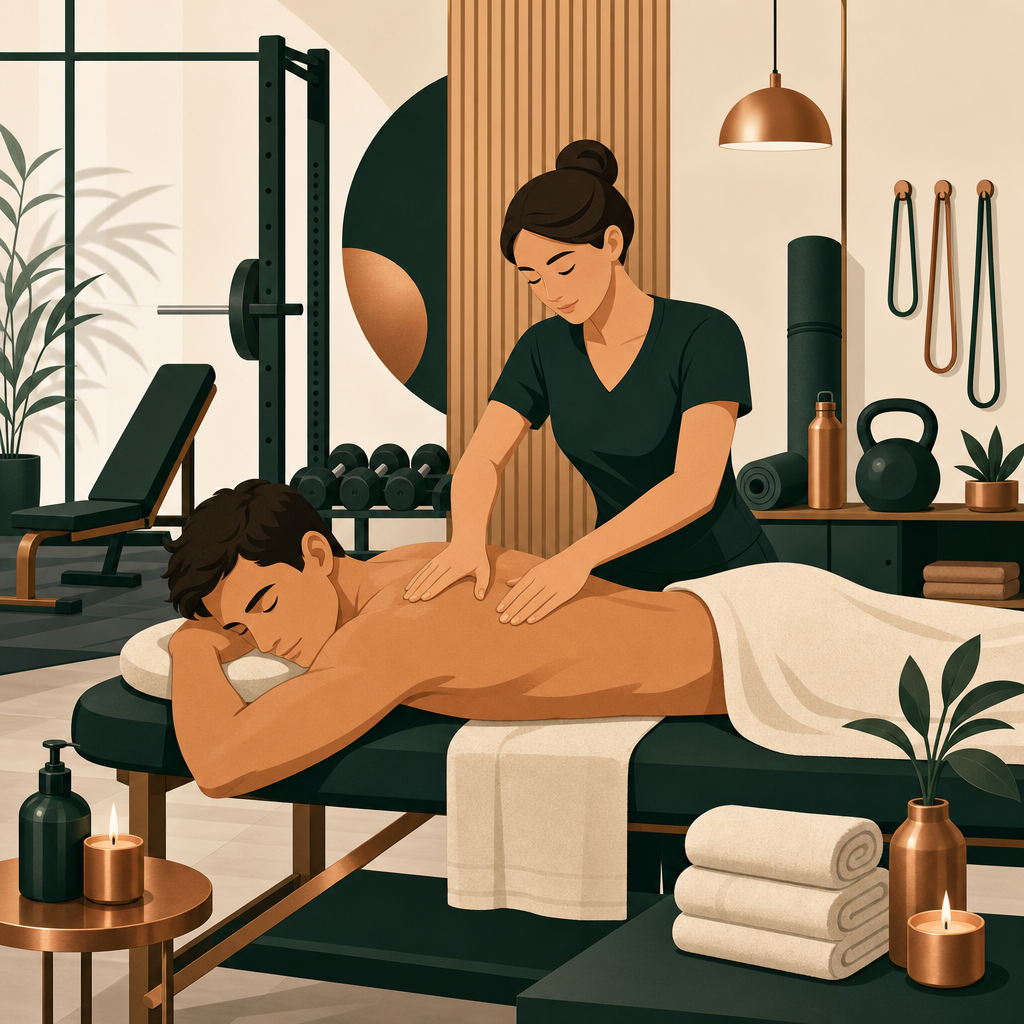
Gym Recovery 101: Pre-Workout vs Post-Workout Massage Timing
The Question Every Gym-Goer Asks
It starts the same way every time. A new client walks into my therapy room at Raipur Spa, and somewhere between the intake form and the first question, they look at me with that familiar mix of hope and confusion.
"So," they ask, "should I get a massage before my workout or after?"
It seems like a simple question. And I wish I could give you a simple answer like "always before" or "always after." But the truth, as with most things in fitness, is that it depends on what you're trying to achieve. A pre-workout massage serves a completely different purpose than a post-workout massage. And using the wrong type at the wrong time can actually work against your goals.
I remember one particular client — a serious powerlifter from Samta Colony who had been training for years. He had booked a deep tissue massage two hours before his leg day. He told me he wanted to "loosen up" his quads. I advised against it, but he insisted. The result? He felt weak and wobbly during his squats, couldn't hit his working weight, and felt more sore than usual the next day. He had essentially sedated his muscles right before asking them to perform at maximum capacity.
That's the kind of mistake that happens when you don't understand the science behind massage timing. So let's fix that. Let me walk you through what the research actually says about pre-workout versus post-workout massage, and how to use both to your advantage.
The Science of Pre-Workout Massage: More Than Just "Warming Up"
A pre-workout massage is not about breaking down adhesions or fixing chronic tightness. It's about preparing your neuromuscular system for the work ahead. And the research on this is actually quite interesting.
Several studies have looked at the effects of pre-exercise massage on performance. The most relevant one, published in the Journal of Strength and Conditioning Research, found that a 15-minute massage on the quadriceps before exercise produced small but measurable improvements in range of motion and a reduction in the perception of effort during subsequent exercise. Another study looked at pre-massage effects on vertical jump performance and found that participants who received a pre-exercise massage had slightly better jump height than those who didn't.
But — and this is a crucial but — these studies used very specific protocols. The massage was short (10-15 minutes), relatively light in pressure, and focused on mobilising the tissue rather than "working into" it. This is very different from the kind of deep tissue massage most people think of when they hear the word.
What a good pre-workout massage does:
- Increases blood flow locally — bringing oxygen and nutrients to the muscles about to be worked
- Improves joint range of motion — particularly useful for compound lifts like squats, deadlifts, and overhead press
- Reduces muscle tension — allowing for more efficient movement patterns
- Enhances proprioception — your brain's awareness of where your body is in space
- Prepares the nervous system — activating the neural pathways that control the targeted muscles
What a good pre-workout massage does NOT do: break down fascia, release deep trigger points, or address chronic adhesions. Those things require pressure and duration that would actually hinder your workout performance.
I tell my gym clients that a pre-workout massage should feel like a good warm-up, not like a therapy session. It should leave you feeling loose, mobile, and ready to move — not tender, bruised, or "worked on."
How to Time Your Pre-Workout Massage
Let's get specific. You want to use massage to enhance your gym session. Here's my protocol:
For a morning workout: If you train first thing, consider getting a pre-workout massage the evening before. A light to moderate pressure session focused on the muscle groups you plan to train the next morning can improve your range of motion and reduce stiffness. This works especially well if you train legs in the morning, when your body is naturally stiffer.
For an afternoon or evening workout: A short pre-workout massage 30 minutes before you train can be effective. Keep it to 10-15 minutes. Focus on the major muscle groups you're about to train. Use moderate pressure — enough to mobilise the tissue but not deep enough to cause discomfort. The therapist should be using broad compression, gentle stretching, and joint mobilisation techniques, not deep stripping or trigger point work.
The window to avoid: Don't get a deep tissue massage within 24 hours of a heavy training session. I cannot stress this enough. Deep tissue work creates micro-trauma in the muscles — that's actually part of how it works. If you then go and lift heavy weights on top of that, you're essentially doubling the damage load. Your body can't recover from both at the same time effectively.
The Post-Workout Massage: When and How
Post-workout massage is where most of the recovery benefits live. But again, timing matters.
The immediate post-exercise period — within 30 to 60 minutes of finishing your workout — is not ideal for deep massage. Your muscles are engorged with blood. Your heart rate is still elevated. Your nervous system is in a sympathetic (fight-or-flight) state. Trying to do deep work at this point is uncomfortable for the client and less effective for the therapist.
The sweet spot for post-workout massage is 2 to 24 hours after training. This gives your body time to begin its natural recovery processes — blood flow normalises, inflammation begins to be managed, and your nervous system transitions back to a parasympathetic (rest-and-digest) state. Massage at this point can enhance these natural processes rather than interfere with them.
I had a client — a bodybuilder who trains six days a week — who used to come to me immediately after his leg day. He was still sweating, his heart was pounding, and his legs were shaking. I told him to go home, eat, shower, and come back the next day. He insisted on trying. Fifteen minutes into the session, he was in so much discomfort that we had to stop. The next week, he came in the morning after his leg day. Different experience entirely. His muscles were more receptive, he could tolerate appropriate pressure, and he walked out feeling significantly better than when he arrived.
For post-workout recovery, I use a combination of:
- Myofascial release — sustained, gentle pressure to lengthen tight fascia and improve tissue glide
- Effleurage and petrissage — the classic Swedish techniques that promote blood flow and lymphatic drainage
- Specific trigger point therapy — addressing the knots and tight bands that developed during training
- Passive stretching — gently lengthening the muscles that were worked concentrically (shortened) during training
The pressure should be moderate to moderately firm — enough to address restrictions but not so deep that it creates additional soreness. A good post-workout massage should leave you feeling relaxed, not tender.
The Optimal Frequency: How Often Should Gym-Goers Get Massage?
This varies depending on your training volume, intensity, and goals. But here's a general framework based on what I've seen work for hundreds of gym clients at Raipur Spa:
Casual gym-goers (3-4 days per week, moderate intensity): One massage every 2-3 weeks is sufficient for maintenance. Focus on the muscle groups you train most frequently. A single session can address multiple areas.
Intermediate to advanced lifters (4-5 days per week, moderate to high intensity): Weekly massage is ideal if your budget and schedule allow it. Every session doesn't need to be a full-body deep tissue — alternate between targeted sessions (focusing on one or two problem areas) and full-body maintenance sessions.
Competitive athletes and powerlifters (5-6 days per week, high intensity): Two sessions per week is not unreasonable. One session focused on recovery and one focused on maintenance. The recovery session should come within 24 hours of your heaviest training day. The maintenance session can be at any other point in the week.
During a deload week: This is actually the perfect time for a deeper, more comprehensive massage session. Since your training volume is reduced, your body has more recovery capacity to handle the micro-trauma of deep tissue work. Book a thorough session during your deload week, and you'll come back to your next training block feeling like a new person.
The "Worst Time" to Get a Massage
Let me be clear about when NOT to get a massage if you're a regular gym-goer:
- Immediately before a max-effort lift or competition. Massage can reduce muscle tension to the point where you lose some of the stiffness that actually helps with heavy lifts. This is called the "tension paradox" — some level of muscle tension is necessary for maximal force production, and massage reduces it.
- Immediately after an extremely taxing session. Your body is in a catabolic state. It needs nutrients and rest, not manual therapy. Let the recovery process begin naturally before adding massage on top.
- When you're already sore from a previous session. Massage on already-sore muscles can be done, but it should be very light — essentially just gentle circulation work. Don't ask for deep tissue on muscles that are still recovering from a previous workout.
- When you're sick or fighting off an infection. Your immune system is already working hard. Massage can temporarily increase inflammation markers, which doesn't help when your body is fighting a pathogen.
Different Training Styles, Different Massage Needs
Not all gym training is the same. The massage approach that's perfect for a powerlifter is different from what a CrossFitter needs, which is different from what a bodybuilder needs. Let me break it down by training style.
For Powerlifters and Strength Athletes
Powerlifters need their muscles to be strong and stable, but also mobile enough to achieve proper position in the squat, bench, and deadlift. Tight shoulders can prevent you from getting into a proper low-bar squat position. Tight hips can ruin your deadlift setup. Tight pecs can limit your bench press range of motion.
For powerlifters, I focus on the "gateway" muscles — the ones that, when tight, limit performance across multiple lifts. The pecs, lats, hip flexors, glutes, and hamstrings. I also spend significant time on the thoracic spine — mobility here is often the missing link between shoulder issues and poor squat positioning.
One powerlifter I work with from Raipur had been stuck at a 140-kilogram bench press for nearly a year. We started working on his pec minor and anterior shoulder capsule, along with thoracic spine mobility work. Within six weeks, he hit 150 kilograms. He credits the massage entirely. I give some credit to his own hard work too. But the point stands — mobility restrictions can be a genuine limit on strength.
For Bodybuilders and Hypertrophy Seekers
Bodybuilders need muscle recovery and fascia health. The fascia — the connective tissue that wraps around your muscles — can become restricted with heavy training, limiting muscle expansion and potentially inhibiting growth. Regular myofascial release and deep tissue work can help maintain healthy fascia.
For bodybuilders, I recommend targeting the specific muscle groups trained in the most recent session, with a focus on flushing metabolic waste and reducing trigger points. The "pump" that bodybuilders love in the gym is actually caused by blood and fluid rushing into the muscle. Massage helps drain that out and replace it with fresh, nutrient-rich blood.
For General Fitness Enthusiasts
If you're training for general health — mixing strength training with cardio and some flexibility work — you'll benefit most from full-body maintenance massage. Every 2-3 weeks, a session that covers all the major muscle groups with moderate pressure. The goal isn't to fix specific problems (though that will happen incidentally) but to keep everything moving well.
The Role of Self-Massage and Tools
Professional massage is excellent, but it's expensive and time-consuming. You can extend the benefits between sessions with proper self-care.
I recommend that all my gym clients have three tools at home: a lacrosse ball (for pinpoint trigger point work), a foam roller (for general myofascial release), and a massage gun (with the understanding that it has limitations).
The massage gun, by the way, is not a substitute for professional massage. It's excellent for a quick warm-up before training or a brief cool-down after. But it cannot replicate the assessment skills, the specificity of technique, or the duration of treatment that a trained therapist provides. Use your massage gun daily for maintenance. But don't think it replaces the real thing.
Final Thoughts: Building Massage Into Your Training Programme
Here's the framework I want you to take away from this article:
Pre-workout massage — light, short, focused on mobility. Use it before your session or the night before. Think of it as part of your warm-up.
Post-workout massage — moderate pressure, focused on recovery. Get it 2-24 hours after training. Think of it as optimisation for your recovery.
Maintenance massage — deeper, more comprehensive. Schedule it during deload weeks or as a regular weekly/biweekly practice. Think of it as the oil change for your body.
And above all, listen to your body. Some weeks you'll feel great and a light maintenance session is all you need. Other weeks — heavy training weeks, high stress, poor sleep — you'll benefit from more focused recovery work. The best approach is to build a relationship with a therapist who understands your training and can adapt the work to your current state.
If you're in Raipur, come see me at Raipur Spa in Samta Colony. I'll work with you to understand your training, your goals, and the best timing strategy for your massage sessions. Because the right massage at the right time can make the difference between a good training cycle and a great one.
People Also Ask
Related Articles

Sports, Fitness & Weight Management
Post-Marathon Recovery: A Runner's Guide to Massage Therapy
15 min read · 12 May 2026
Sports, Fitness & Weight Management
Cricket Injury Prevention: Massage for Bowlers and Batsmen
12 min read · 12 May 2026

Sports, Fitness & Weight Management
Yoga and Massage: The Perfect Wellness Combo for Flexibility
12 min read · 12 May 2026
Enjoyed This Article?
Stop reading about relaxation — come experience it firsthand at Raipur SPA.