CrossFit Recovery: How Regular Massage Helps You Train Harder
The CrossFit Conundrum: Train Harder vs Recover Smarter
CrossFit has a culture problem. And I say this as someone who genuinely respects what the sport does for people. The culture I'm talking about is the one that glorifies pushing through pain, that treats soreness as a badge of honour, that measures success by how wrecked you feel after a workout.
I see it every week at Raipur Spa. A CrossFitter walks into my therapy room, barely able to move their shoulders. They describe their training: five or six days a week, high-intensity metcons, heavy lifting, gymnastics skills work. When I ask about recovery, they shrug. "I foam roll sometimes," they say. "When I remember."
And I understand the impulse. CrossFit is addictive. The community, the competition, the constant challenge — it pulls you in and makes you want to push harder every single day. But here's the truth that the loudest voices in the community don't always say: you don't get stronger during the workout. You get stronger between workouts, during recovery. If you're not recovering properly, you're not getting stronger. You're just running your body into the ground.
Rohan is a perfect example. He started CrossFit about two years ago in Raipur and fell in love with it. He went from being a casual gym-goer to training five days a week, hitting PRs on his lifts, finishing in the top ten at local competitions. But six months in, he hit a wall. His Fran time stopped improving. His snatch stalled at the same weight for weeks. And his shoulders — they constantly ached.
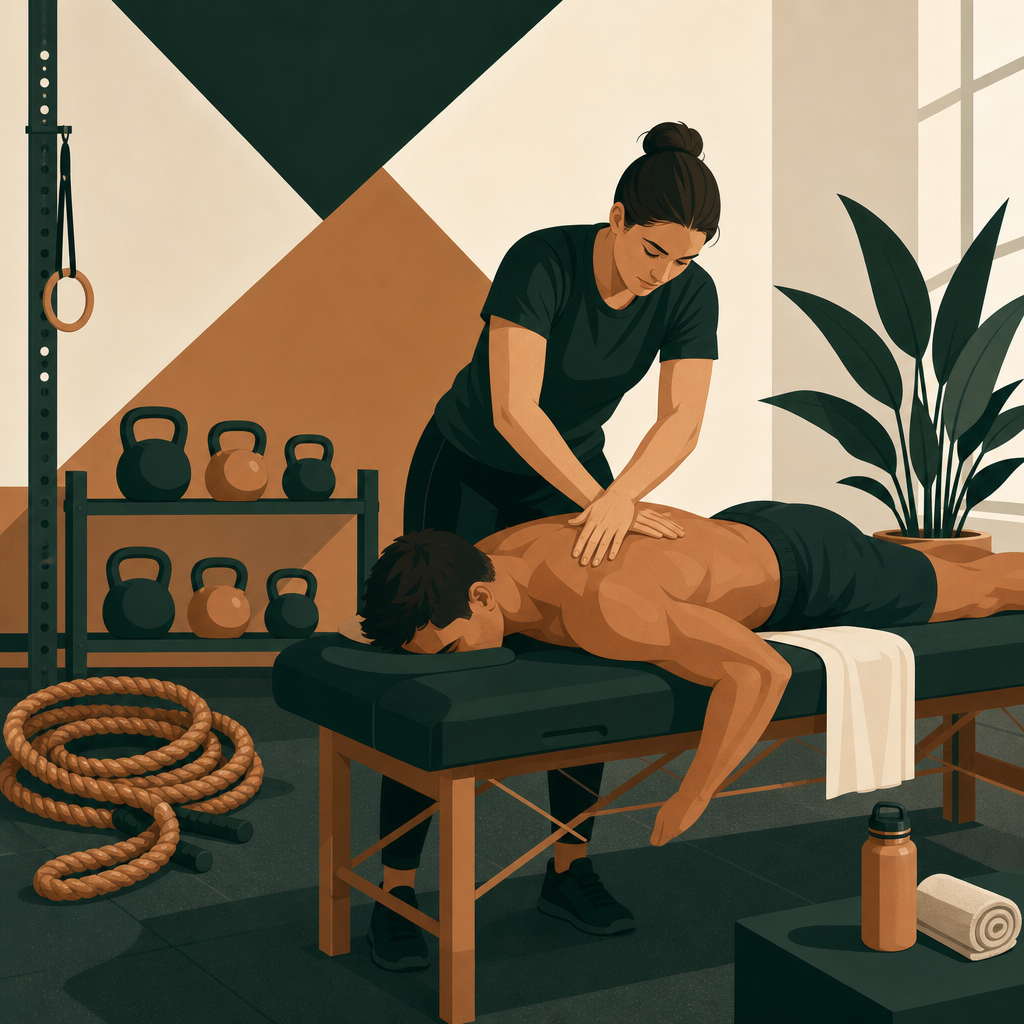
He came to me thinking he needed to train more. More accessory work, more skill practice, more conditioning. My prescription was the opposite. I told him he needed to recover better. Specifically, I told him he needed regular sports massage as part of his training programme. He was sceptical — massage for CrossFit? — but he agreed to try it for a month.
Within three weeks, his shoulder pain was gone. Within six weeks, his Fran time dropped by 45 seconds. Within three months, he hit a new snatch PR. He tells everyone now that regular massage was the missing piece in his training.
This article is for every CrossFitter who wants to train harder, recover faster, and stay in the game for the long haul. Let's get into the specifics.
What CrossFit Does to Your Body
Before we talk about recovery, let's understand what you're recovering from. CrossFit is unique because it combines multiple training modalities — weightlifting, gymnastics, and monostructural cardio — often in the same session, at high intensity. This creates a recovery challenge that's different from any single-sport athlete.
Metabolic stress: High-intensity metcons produce massive amounts of metabolic waste. Lactic acid, hydrogen ions, and other byproducts accumulate in your muscles, creating the burn you feel during a workout. Most of this clears within an hour or two, but the cellular damage that produced it takes days to repair.
Mechanical stress: Olympic lifts, pull-ups, muscle-ups, box jumps — these movements place enormous mechanical load on your joints and connective tissue. The shoulders, in particular, take a beating in CrossFit. So do the knees, the lower back, and the wrists.
Neurological stress: CrossFit demands coordination, power, and precision under fatigue. This places significant stress on your central nervous system. After a few days of intense training, your CNS can become depleted, leading to decreased coordination, longer reaction times, and a general feeling of being "flat."
Inflammatory response: All of the above triggers an inflammatory response. Micro-tears in muscle fibres, joint irritation, connective tissue stress — your body responds with inflammation, which is necessary for healing but uncomfortable and potentially harmful if it becomes chronic.
The Five Most Common CrossFit Injuries (and How Massage Helps)
After working with dozens of CrossFit athletes in Raipur, I've seen the same injury patterns emerge again and again. Here's what they are and how massage can help.
1. Shoulder Impingement and Rotator Cuff Issues
This is the number one CrossFit injury in my experience. The combination of overhead lifting (snatch, overhead squat, push jerk), high-repetition gymnastics (pull-ups, kipping, muscle-ups), and the range of motion demands of movements like the thruster creates the perfect storm for shoulder problems.
The typical pattern: the anterior shoulder — specifically the pectoralis minor and anterior deltoid — becomes tight and short. This pulls the shoulder blade forward and upward, narrowing the subacromial space where the rotator cuff tendons live. When you then raise your arm overhead, the tendons get pinched. That's impingement. It hurts, and if you don't address it, it can lead to tears.
Massage helps by releasing the tight anterior structures, restoring normal scapular mechanics, and reducing tension in the rotator cuff muscles themselves. I focus on the pectoralis minor, the anterior deltoid, the biceps tendon, and then work on the posterior cuff — the infraspinatus and teres minor — to restore balance around the joint.
One CrossFit athlete I work with from Samta Colony had been dealing with shoulder pain for nearly a year. He had tried everything — rest, ice, anti-inflammatories, changing his technique. Nothing worked. In our first session, I found that his right pectoralis minor was so tight it felt like a steel cable. Twenty minutes of focused release work, and his shoulder range of motion improved by what he estimated was 40%. Three sessions later, his pain was gone. He hasn't missed a workout since.
2. Lower Back Strain
Deadlifts, cleans, snatches, kettlebell swings — CrossFit is full of movements that load the lower back. When your core is strong and your form is good, these movements are safe and effective. But under fatigue — and CrossFit is all about training under fatigue — form breaks down, and the lower back takes the brunt of the load.
Acute lower back strains are common in CrossFit. But what I see more often is the chronic low-grade tightness that never quite becomes an injury but never quite goes away either. It's that feeling of stiffness in the lower back that makes you wince when you bend over to tie your shoes.
This chronic tightness is usually caused by overworked erector spinae muscles going into spasm. The spasm restricts blood flow, which means the muscles aren't getting the oxygen and nutrients they need to recover. Massage breaks this cycle by releasing the spasm, restoring blood flow, and allowing the muscles to return to their normal resting length.
I also work on the quadratus lumborum — a deep muscle on the side of the lower back that gets extremely tight in CrossFitters — and the glutes, which are often weak or inhibited in people with recurrent back issues.
3. Achilles Tendinopathy and Calf Tightness
Jumping rope, box jumps, running, double-unders — CrossFit involves a lot of explosive lower leg work that puts stress on the Achilles tendon. When the calves are tight — and they almost always are in CrossFitters — the Achilles has to work harder to absorb shock, which can lead to tendinopathy.
Massage of the calves is essential for preventing Achilles issues. The gastrocnemius and soleus need regular release to stay flexible and reduce the load on the Achilles. I use a combination of deep stripping along the calf muscles, trigger point work on the soleus (which is often missed in self-massage), and gentle stretching to maintain length.
If you're already dealing with Achilles pain, I recommend combining calf massage with eccentric heel drop exercises — the Alfredson protocol — which has strong evidence for treating Achilles tendinopathy. Massage prepares the tissue for the exercise by improving flexibility and blood flow.
4. Knee Pain (Patellar and IT Band Related)
CrossFitters get knee pain from two main sources. The first is patellar tendinopathy — pain at the front of the knee where the patellar tendon attaches to the shin bone. This is common in athletes who do a lot of box jumps, wall balls, and squats.
Massage of the quadriceps can help here. Tight quads pull on the patella through the quadriceps tendon, increasing the load on the patellar tendon. Release the quads, and the pressure on the patellar tendon decreases.
The second source is IT band friction syndrome — pain on the outside of the knee. As I've said elsewhere, the IT band itself shouldn't be directly massaged. Instead, I release the tensor fasciae latae (TFL) and gluteus maximus, which attach to the IT band and control its tension. I also work on the vastus lateralis — the outer quad muscle — which tends to become overactive in people with knee pain.
5. Wrist Pain
Handstand push-ups, front rack position in cleans, snatches, push-ups — CrossFit demands a lot from your wrists. And the wrists are not built for the kind of weight-bearing load that CrossFit puts on them, especially in extreme ranges of motion.
Wrist pain in CrossFit usually comes from tight forearm muscles — both flexors and extensors — which restrict wrist mobility and put extra load on the wrist joints. Massage of the forearms, combined with gentle mobilisation of the carpal bones, can significantly improve wrist comfort and function.
I also teach my CrossFit clients self-massage techniques for the forearms that they can do daily, especially during competition prep or high-volume training periods.
The "Couch Stretch" Problem: Why Passive Stretching Isn't Enough for CrossFitters
If you've been in CrossFit for any length of time, you've been told to do the couch stretch — the lunge-style stretch for the hip flexors. And it's a good stretch. But here's the problem: for many CrossFitters, especially those with lots of volume in Olympic lifting and squatting, the hip flexors aren't just tight because they're short. They're tight because they're overworked and holding trigger points.
Stretching a muscle that's full of trigger points is like trying to straighten a rope that has knots in it. You can pull on the ends all you want, but until you release the knots, the rope won't straighten. That's where massage comes in.
I've had countless CrossFitters tell me that their "tight hips" didn't respond to stretching no matter how often or how long they did it. After a few sessions of focused work on the hip flexors — particularly the rectus femoris and psoas — they find that the stretching actually works again. The muscles are ready to be stretched because the trigger points have been addressed.
The lesson: stretching is important, but it's not always enough. If you're stretching consistently and not seeing progress, you may need manual therapy to release the deeper restrictions first. Stretch after the massage, when the tissue is receptive.
A CrossFit-Specific Massage Schedule
Based on my experience with CrossFit athletes in Raipur, here's a schedule that works:
For the average CrossFitter (3-5 days per week):
- One sports massage every 2 weeks during regular training periods
- Weekly massage during competition prep or high-volume training blocks
- Focus on: shoulders, lower back, calves, and any problem areas
Before a competition:
- A light maintenance session 3-4 days before the event — keep it light, just mobilising and relaxing
- No deep work in the 72 hours before competition
- Self-massage and mobilisation on the day before, focusing on areas you'll need most
After a competition or particularly intense training block:
- Book a recovery session within 24-48 hours
- This session should be focused on flushing metabolic waste, not on deep tissue structural work
- Combine with rest, good nutrition, and plenty of sleep
Off-season or deload periods:
- This is the time for deeper, more comprehensive work
- Focus on correcting imbalances and addressing chronic issues
- Weekly sessions can help reset your body before ramping up training again
The Nutrition and Sleep Piece of the Puzzle
I can't write this article without mentioning the other pillars of recovery. Massage is powerful, but it's not magic. It works best in combination with proper nutrition, hydration, and sleep.
For CrossFit recovery, I recommend:
- Protein within 30 minutes of training: 20-40 grams, depending on your body weight and training intensity. Whey protein is convenient, but whole food sources work just as well.
- Carbohydrates to replenish glycogen: CrossFit depletes glycogen stores significantly. Don't be afraid of carbs, especially around your training sessions.
- Hydration: CrossFitters sweat. A lot. Aim for 3-4 litres of water per day, more if you're training in Raipur's heat. Add electrolytes if you're a heavy sweater.
- Sleep: 7-9 hours minimum. Sleep is when your body releases growth hormone and repairs tissue. If you're chronically sleep-deprived, no amount of massage will fix your recovery.
The Mind-Body Connection
One thing I've noticed about CrossFitters who benefit most from massage: they're the ones who treat it as more than just a physical intervention. They approach it with the same mindset they bring to their training — present, focused, and willing to lean into discomfort.
Massage gives you a unique opportunity to check in with your body. As a therapist works on your shoulders, you become aware of tension you didn't even know you were holding. You notice the asymmetry between your left and right sides. You feel where your body is tight and where it's loose. That awareness carries over into your training, helping you move more intelligently and with better body awareness.
I had one CrossFit athlete who told me that regular massage had completely changed how she approached her training. She used to just go to the box and do whatever the whiteboard said, regardless of how her body felt. Now, she makes choices based on her body's feedback — scaling when needed, choosing different movements, taking rest days when her body tells her to. She's actually training HARDER now, because she's training smarter. Her recovery is better, so her performance is better.
That's the paradox at the heart of CrossFit recovery. The harder you push, the more you need to recover. And the better you recover, the harder you can push. It's a virtuous cycle — but only if you're intentional about both sides of the equation.
Final Thoughts: Don't Be a Hero
CrossFit culture can make you feel like you should always be chasing the next PR, the next RX, the next competition. And that drive is part of what makes CrossFitters so impressive. But it can also be your downfall if you don't balance it with proper recovery.
I'm not telling you to train less. I'm telling you to recover more deliberately. Schedule your massage sessions the same way you schedule your training sessions. Think of them as part of your programme, not as an optional add-on.
If you're in Raipur and you're serious about CrossFit, come see me at Raipur Spa in Samta Colony. I understand what your body goes through in every WOD, and I know how to help it recover. Don't be a hero on recovery days. Be smart. Your next PR depends on it.
People Also Ask
Related Articles
Sports, Fitness & Weight Management
Post-Marathon Recovery: A Runner's Guide to Massage Therapy
15 min read · 12 May 2026
Sports, Fitness & Weight Management
Cricket Injury Prevention: Massage for Bowlers and Batsmen
12 min read · 12 May 2026
Sports, Fitness & Weight Management
Gym Recovery 101: Pre-Workout vs Post-Workout Massage Timing
11 min read · 12 May 2026
Enjoyed This Article?
Stop reading about relaxation — come experience it firsthand at Raipur SPA.