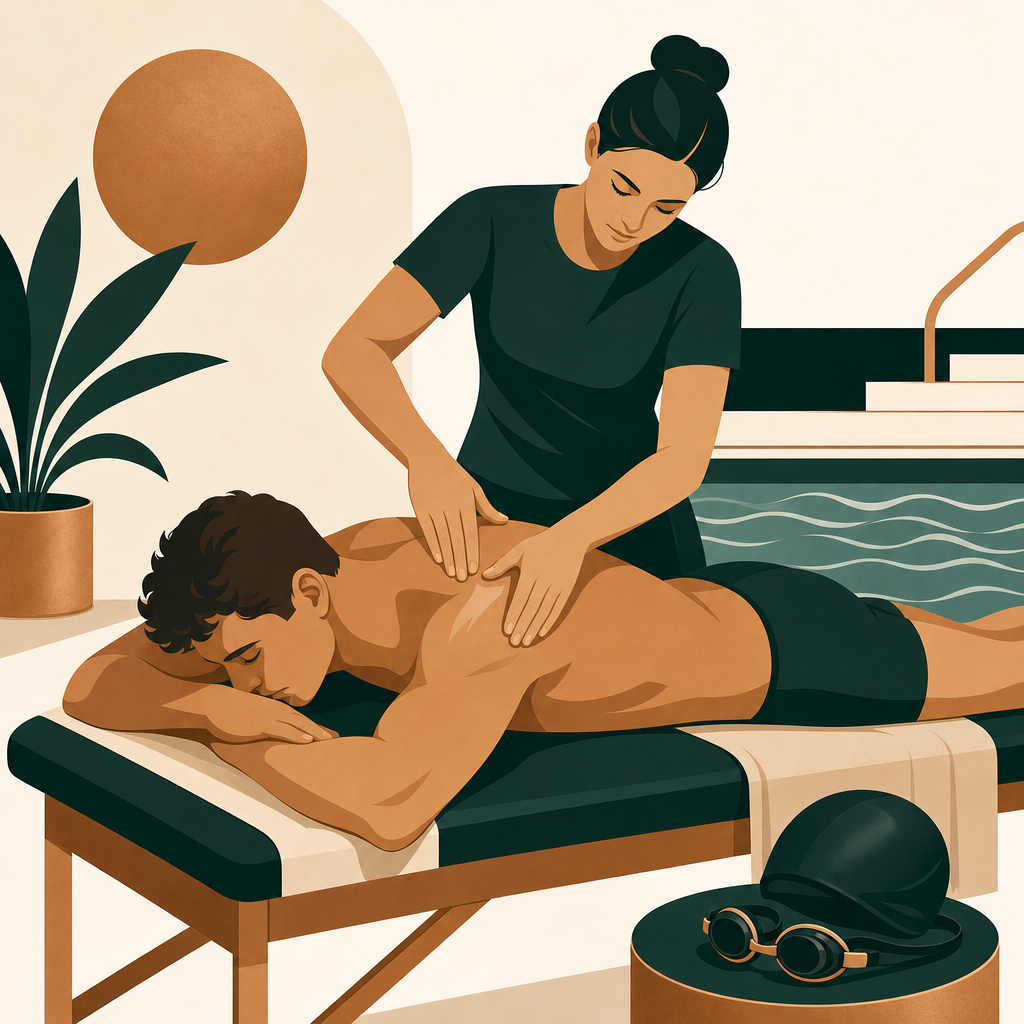
Swimmer's Shoulder: Targeted Massage to Prevent and Heal
My Introduction to the Problem
The first competitive swimmer I ever treated was a 16-year-old girl named Ananya. She had been swimming since she was seven, training six days a week, doing 5,000 to 6,000 metres per session. She was good — genuinely good — with state-level medals and ambitions of swimming at the national level. She came to my therapy room at Raipur Spa in Samta Colony with her mother, looking frustrated and exhausted.
"My shoulder has been hurting for three months," she told me. "I've tried resting it. I took two weeks off. But the moment I get back in the pool and do a few laps of freestyle, the pain comes right back."
I asked her to show me where it hurt. She pointed to the front of her shoulder. Then she pointed to the top. Then to the back. "It's just... the whole thing," she said.
That was my first real encounter with "swimmer's shoulder." And as I've since learned, it's not a single condition with a single cause. It's a collection of problems — impingement, tendinopathy, instability, muscle imbalances — that all converge on the shoulder joint of anyone who swims with any serious volume.
Ananya's case turned out to be classic. Her pectoralis minor and anterior deltoid were extremely tight, pulling her shoulder blade forward and narrowing the space under her acromion (the bony projection at the top of the shoulder). Her posterior rotator cuff — the infraspinatus and teres minor — was comparatively weak and inhibited. This is the classic swimmer's imbalance: too much tightness in the front, not enough strength in the back.
We worked together for eight weeks. Weekly massage sessions to release the tight anterior structures and address trigger points in the rotator cuff. A strengthening programme for her posterior shoulder. Some technique modifications recommended by her coach. At the end of those eight weeks, she swam 5,000 metres with zero pain. She went on to qualify for nationals that year.
Stories like Ananya's are why I'm writing this. Swimmer's shoulder is preventable. It's treatable. But the approach needs to be specific and informed, not generic. Here's what I've learned.
What Exactly Is "Swimmer's Shoulder"?
"Swimmer's shoulder" is the catch-all term for shoulder pain in swimmers. And I hate catch-all terms because they make it sound like a single thing with a single solution. It's not. But let me explain what most cases have in common.
The swimming stroke — freestyle in particular — involves repetitive overhead motion. Your arm enters the water, pulls through, exits, and recovers overhead. In a single 2,000-metre training session, a swimmer might perform 1,500 to 2,000 of these strokes per arm. That's 2,000 times each shoulder goes through that extreme range of motion. Day after day. Week after week.
The problem isn't the range of motion itself. The shoulder is designed to be mobile — it's the most mobile joint in the human body. The problem is that the muscles controlling that motion become imbalanced. The front gets tight. The back gets weak. The mechanics of the stroke deteriorate. And eventually, something hurts.
The most common pathologies under the "swimmer's shoulder" umbrella are:
- Subacromial impingement: The supraspinatus tendon or subacromial bursa gets pinched between the humeral head and the acromion during overhead motion
- Supraspinatus tendinopathy: Inflammation or degeneration of the supraspinatus tendon from repetitive overload
- Biceps tendinopathy: Irritation of the long head of the biceps tendon, which passes through the shoulder joint
- Posterior capsular tightness: The back of the shoulder joint capsule becomes tight, limiting internal rotation and altering mechanics
- Scapular dyskinesis: The shoulder blade stops moving properly on the ribcage, altering the mechanics of the entire shoulder complex
Most swimmers I see have more than one of these happening simultaneously. It's a cascade — one problem leads to the next. Which is why treating it requires a comprehensive approach.
The Muscle Imbalance That Plagues Every Swimmer
Let me draw you a picture of the typical swimmer's shoulder.
In the front: the pectoralis major and minor are tight. The anterior deltoid is tight. The latissimus dorsi (which wraps from the back to the front of the shoulder) is tight. The biceps brachii is tight. These muscles are overworked because they're the primary movers in the pull phase of the stroke.
In the back: the infraspinatus, teres minor, and posterior deltoid are comparatively weak and often inhibited. The middle and lower trapezius — muscles that stabilise the shoulder blade — are underdeveloped. The rhomboids are stretched and weak.
This imbalance has mechanical consequences. The tight front muscles pull the shoulder blade forward and into a position called "protraction." The head of the humerus (upper arm bone) shifts forward in the socket. The subacromial space — the gap where the rotator cuff tendons live — narrows. Every time the swimmer raises their arm, those tendons get compressed.
And here's the kicker: swimming doesn't naturally strengthen the posterior shoulder. The pull phase of all four competitive strokes — freestyle, backstroke, breaststroke, butterfly — primarily works the front of the shoulder. The recovery phase, which requires posterior shoulder control, is mostly passive. So the imbalance gets worse the more you swim.
How Massage Addresses Swimmer's Shoulder
Massage therapy is uniquely suited to address the muscular component of swimmer's shoulder. Here's my protocol.
Step 1: Release the Anterior Chain
I start with the pec minor. This is a small muscle that attaches from the ribs to the coracoid process of the shoulder blade. When it's tight — and it almost always is in swimmers — it tilts the shoulder blade forward, contributing to impingement. I use very specific, sustained pressure on the pec minor, sometimes holding for 2-3 minutes until I feel the muscle release.
Next, the pec major. I use stripping techniques along the length of the muscle fibres, paying special attention to the clavicular head (the upper part) which is most involved in the swimming stroke. The subclavius — a tiny muscle just under the collarbone — often needs attention too.
Then the anterior deltoid. This muscle gets worked hard in every stroke. I use broad compression and gentle stripping, careful not to overwork it because it's already fatigued from swimming.
Finally, the latissimus dorsi and teres major. These are the big muscles that power the pull phase. They get extremely tight in swimmers, especially in the axilla (armpit) area. I use a combination of compression, stripping, and gentle stretching to release them.
Step 2: Address the Rotator Cuff
The rotator cuff — specifically the infraspinatus and teres minor — needs careful, specific work. These muscles are usually not just tight; they're full of trigger points from being constantly overworked in a lengthened position.
I use pinpoint trigger point therapy on these muscles, locating the tender spots and applying sustained pressure until they release. The infraspinatus, for example, is a common source of referred pain into the shoulder and down the arm. I've had swimmers tell me that they've been to multiple doctors who couldn't find the source of their pain — and it was just a group of trigger points in the infraspinatus that had been there for months.
The supraspinatus — the most commonly injured rotator cuff tendon — needs gentler work. It sits in a tight space between bones, and aggressive massage can actually irritate it further. I use very light, superficial techniques around the tendon itself, focusing more on the muscles that surround and support it.
Step 3: Mobilise the Scapula
The shoulder blade (scapula) is the foundation of shoulder function. If the scapula isn't moving properly, the shoulder can't work properly. But the muscles that control the scapula — the trapezius, rhomboids, serratus anterior, levator scapulae — are often neglected in massage.
I spend significant time on the muscles that attach to the scapula. The rhomboids, which retract the shoulder blade, are often weak and overstretched in swimmers, but they can also develop trigger points that refer pain to the shoulder. The middle and lower trapezius fibres need attention to restore normal scapular control. The serratus anterior — a muscle that wraps from the ribs to the shoulder blade — is crucial for proper scapular movement and often holds tension.
I also use gentle mobilisation techniques to improve the movement of the scapula itself. This involves passively moving the shoulder blade through its normal range of motion while the client relaxes. It's a subtle technique that makes a dramatic difference.
Step 4: Release the Neck and Upper Back
Swimmers don't just use their shoulders. They use their entire upper body, and tension in the neck and upper back almost always accompanies swimmer's shoulder. The upper trapezius, levator scapulae, and suboccipital muscles hold a lot of tension from the demands of breathing while swimming — the constant rotation of the head to breathe in freestyle, the hyperextension of the neck in butterfly.
Releasing these muscles improves overall upper body mechanics and reduces the load on the shoulder joint. It also helps with the neck pain that many swimmers develop as a secondary issue.
The Home Care Protocol I Give Every Swimmer
Professional massage is essential, but swimmers need daily self-care to make progress. Here's what I recommend.
The Lacrosse Ball Routine
Three exercises that every swimmer should do daily:
- Pec release: Lie face-down with a lacrosse ball placed just inside your shoulder joint, near the collarbone. This targets the pec minor. Breathe deeply for 2 minutes on each side.
- Infraspinatus release: Lie on your back with a ball placed just inside the shoulder blade. This is a tender area for most swimmers. Hold for 2 minutes per side.
- Lat release: Lie on your side with a ball in your armpit. This releases the lat and teres major. Roll gently for 2 minutes per side.
The Doorway Stretch
Stand in a doorway and place your forearms on the door frame at shoulder height. Gently lean forward until you feel a stretch across your chest. Hold for 30 seconds. Do this three times. This stretches the pectoralis muscles that are tight from swimming.
A variation with your arms placed higher on the frame targets the pec minor more specifically. Another with your arms lower targets the pec major.
External Rotation Strengthening
Massage releases the tight muscles, but the weak posterior muscles need to be strengthened. The single most important exercise for preventing swimmer's shoulder is external rotation with a resistance band.
Attach a band to a fixed point at waist height. Stand with your side to the band, holding it with the hand farther from the anchor. Keep your elbow bent at 90 degrees and tucked against your side. Rotate your forearm outward against the band's resistance. Three sets of 15 repetitions per side, daily.
I cannot overstate how important this exercise is. Most swimmers have weak external rotators, and strengthening them is the single most effective intervention for swimmer's shoulder. Massage prepares the tissue for this exercise by releasing the tight structures that inhibit proper movement.
Swimmer's Shoulder by Stroke
Different strokes create slightly different patterns of strain. Here's what I see most often:
Freestyle: The most common source of swimmer's shoulder. The repetitive overhead motion of the recovery phase combined with the powerful internal rotation of the pull phase creates the classic imbalance pattern. Freestylers tend to have the most pronounced tightness in the pec minor and lats.
Butterfly: The most demanding stroke on the shoulders. The simultaneous overhead recovery of both arms in fly places extreme stress on the rotator cuff. Butterfly swimmers often develop impingement symptoms earlier in their careers than other swimmers. The lower back also takes significant strain from the dolphin kick and undulation.
Backstroke: The internal rotation of the arm during the pull phase in backstroke is different from freestyle, placing more stress on the posterior shoulder. Backstrokers often develop tightness in the posterior deltoid and infraspinatus in addition to the anterior tightness common to all swimmers.
Breaststroke: Breaststrokers typically have less shoulder issues than other swimmers because the stroke doesn't involve the same degree of overhead motion. However, they're more prone to knee problems (breaststroker's knee) from the whip kick, and the wide arm pull can create stress on the elbow.
The Role of Technique in Shoulder Health
I'm a massage therapist, not a swimming coach. But I've learned enough from working with swimmers to know that technique plays a massive role in shoulder health.
Common technique issues that contribute to swimmer's shoulder:
- Crossing the midline: When the hand enters the water past the centreline of the body, it places the shoulder in a position of increased impingement risk
- Early hand exit: Pulling the hand out of the water too early places extra load on the rotator cuff
- Over-rotating on the breathing side: This can create asymmetry, with one shoulder taking more strain than the other
- Dropping the elbow during the pull: This reduces the effectiveness of the pull and increases shoulder stress
If you have persistent shoulder pain despite good massage and strengthening work, I strongly recommend having a coach or experienced swimmer analyse your stroke. Small technique changes can dramatically reduce shoulder load.
When to Seek Help and When to Rest
One of the hardest decisions for a competitive swimmer is deciding when to rest a sore shoulder. The training schedules are demanding, and missing sessions feels like falling behind. But here's the truth: training through shoulder pain doesn't build toughness. It builds dysfunction.
Here's my guideline for swimmers:
- Mild discomfort during warm-up that fades: Usually safe to train. Use the warm-up to assess how the shoulder feels. If it improves with movement, proceed.
- Pain that limits your stroke or causes you to modify your technique: Stop. You're reinforcing bad movement patterns that will be harder to fix later.
- Pain that persists after the session: Take the next day off. If it's still there after a few days of rest, book a therapy session.
- Pain that wakes you up at night: This is a sign of significant inflammation. Rest completely for 3-5 days and seek professional help.
The swimmers who recover fastest from shoulder issues are the ones who catch it early. Don't wait until the pain is severe. A small problem that's been there for a week is easier to fix than a small problem that's been there for six months.
Final Thoughts: The Shoulder That Carries You
Ananya, the young swimmer I started this article with, sends me a message every year after nationals to let me know how she's doing. She's in college now, still swimming, still training hard. And she still comes in for maintenance massage during her peak training periods.
"I learned my lesson," she told me once. "My shoulder is the most important piece of equipment I have. I can buy a new swimsuit. I can buy new goggles. I can't buy a new shoulder."
She's exactly right. If you're a swimmer — whether you're training for nationals, doing open water swims, or just swimming laps for fitness — your shoulders are carrying you through every stroke. Take care of them. Regular massage, proper strengthening, good technique, and smart rest are the keys to keeping them healthy for the long haul.
If you're in Raipur and dealing with shoulder pain from swimming, come see me at Raipur Spa in Samta Colony. I've helped swimmers of all levels — from competitive athletes to recreational lap swimmers — find relief and get back to doing what they love. Your shoulders have carried you through thousands of laps. Let me help carry them for a while.
People Also Ask
Related Articles

Sports, Fitness & Weight Management
Post-Marathon Recovery: A Runner's Guide to Massage Therapy
15 min read · 12 May 2026

Sports, Fitness & Weight Management
Cricket Injury Prevention: Massage for Bowlers and Batsmen
12 min read · 12 May 2026

Sports, Fitness & Weight Management
Gym Recovery 101: Pre-Workout vs Post-Workout Massage Timing
11 min read · 12 May 2026
Enjoyed This Article?
Stop reading about relaxation — come experience it firsthand at Raipur SPA.